


Frequently Asked Questions
Results (4)
Click the question to read the answer.
-
Under the Blue Box Regulation, there are three types of exemptions that apply to producers:
- Based on a producer’s gross annual revenue,
- based on the weight of Blue Box materials supplied into Ontario, and
- for producers of newspaper
1. Any producer whose gross annual Ontario revenue from products and services is less than $2,000,000 is exempt from all producer requirements under the regulation. In the case where the producer is a franchisor, it is the gross annual revenue of the system that is used to determine if an exemption applies.
Any producer who meets the exemption must keep any records that demonstrate its gross annual Ontario revenue is less than $2,000,000 in a paper or electronic format that can be examined or accessed in Ontario for a period of five years from the date of creation.
See our FAQs to understand what revenues municipalities and registered charities should consider when determining whether or not they are an exempt producer.
2. A producer who is above the revenue-based exemption level may still be exempt from performance requirements (collection, management and promotion and education) if their supply weight is below the exemption levels outlined in the table below.
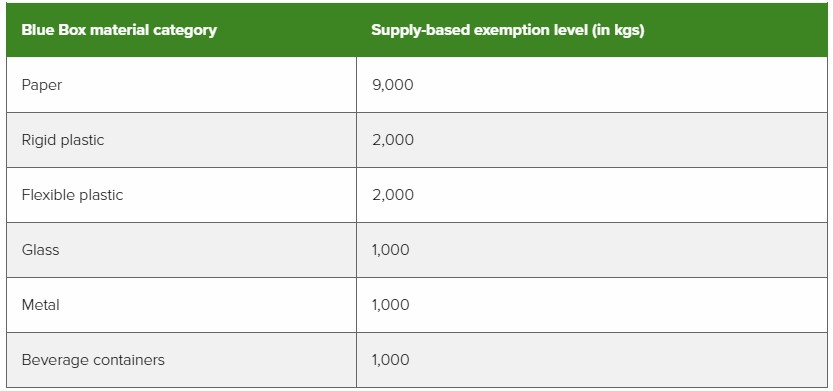
If a producer’s annual revenue is more than $2,000,000 and supply weight in all material categories is less than the tonnage exemption threshold, the producer is required to register and report.
If a producer’s annual revenue is more than $2,000,000 and supply weight in at least one material category is above the tonnage exemption threshold, the producer is required to meet all obligations (registration, reporting, collection, management, and promotion and education). However, producers are only required to meet their minimum management requirement in material categories where they are above the exemption level.
3. As outlined in the amended Blue Box Regulation (released April 19, 2022), producers of newspapers may be exempt from collection, management, and promotion and education requirements. For the purposes of this exemption, “newspapers” includes newspapers and any protective wrapping and any supplemental advertisements and inserts that are provided along with the newspapers.
For a producer to qualify for this exemption, newspapers must account for more than 70% of their total weight of Blue Box materials supplied to consumers in Ontario in a calendar year. If exempt, the producer is not required to meet collection, management, and promotion and education requirements for all Blue Box materials they supply in Ontario in the following two calendar years.
A producer whose newspaper supply accounts for 70% or less of their total weight of Blue Box materials is subject to collection, management, and promotion and education requirements for all Blue Box materials they supply in Ontario.
-
There is an exemption in the Blue Box regulation for producers whose gross annual revenue generated from products and services in Ontario less than $2 million. The revenue that counts towards the exemption is revenue from products and services. Charitable donations are not revenue from products and services and therefore does not count towards the exemption. Revenue other than charitable donations that are recorded from registered charities will be considered revenue from products and services.
-
There is an exemption in the Blue Box Regulation for producers whose gross annual revenue generated from products and services in Ontario is less than $2 million. The following sources are excluded for the purpose of determining revenue:
- Government tax revenue
- Property taxes
- General assistance funding received under the Ontario Municipal Partnership Fund
- Payments in lieu of taxes
- Canadian or Ontarian government grants available to municipalities with the intent of investing in public infrastructure
-
RPRA collects 13% Harmonized Sales Tax (HST) on applicable fees. This requirement is based on a ruling received from the Canada Revenue Agency (CRA), which determined that HST must be charged on fees collected under the Resource Recovery and Circular Economy Act, 2016 (RRCEA).
HST applies to all RRCEA producer responsibility programs, as well as the Excess Soil and Hazardous Waste programs.
Invoices issued before January 1, 2023, were amended to reflect HST. Registrants can access amended invoices in their Registry accounts under the Invoices tab, where the HST amount and the amended invoice date are shown.
Important notes:
- On the amended invoices there have been no changes to the Invoice Total and registrants will not be required to pay any additional monies to RPRA for past invoices.
- Registrants may be able to claim input tax credits for the HST collected on RPRA fees, for both the amended invoices and new invoices issued January 1, 2023, onwards. However, RPRA is not in a position to provide tax advice and suggests you consult your internal or external accountants to seek their counsel.
- All new invoices issued effective January 1, 2023, will contain appropriate information identifying the amount of the HST and other relevant details. These invoices will also be displayed under the “Invoices” tab in a registrants’ Registry account.