




Frequently Asked Questions
Results (11)
Click the question to read the answer.
-
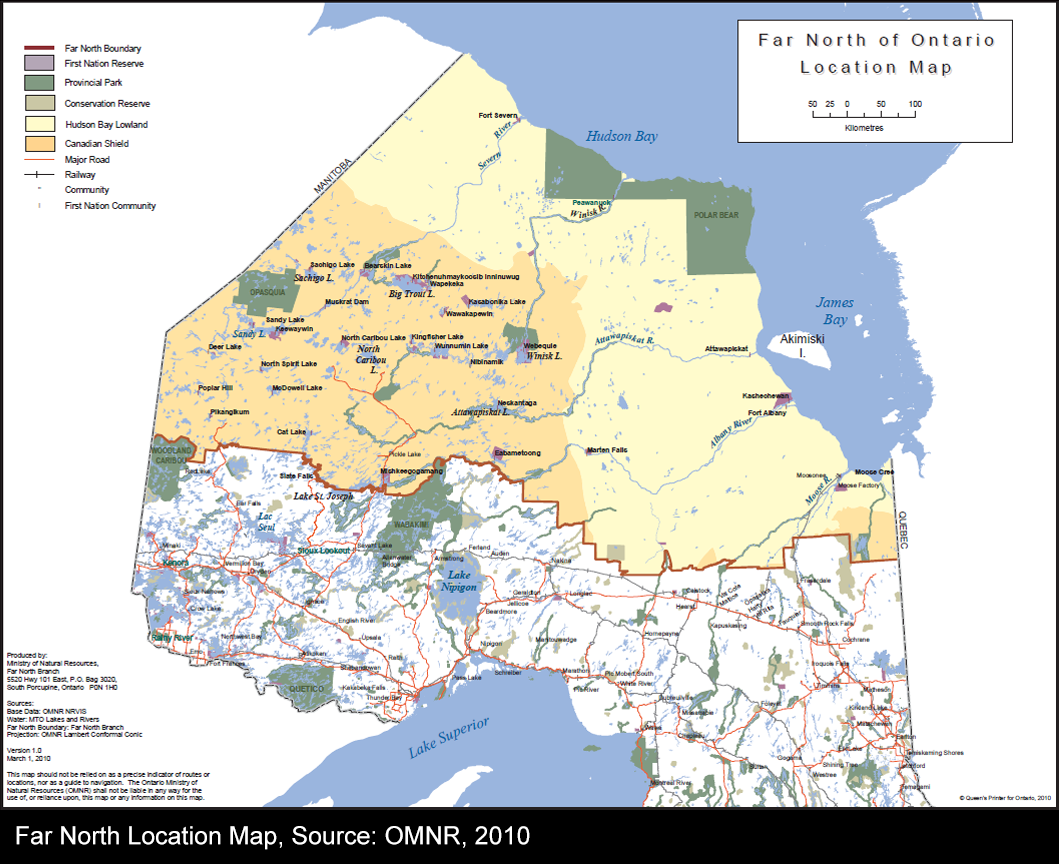
The Far North Boundary is the line between Ontario’s Far North and all communities south of the Far North.
Under the Far North Act, 2010, “Far North” is defined as the portion of Ontario that lies north of the land consisting of:
- Woodland Caribou Provincial Park;
- Red Lake Forest, Trout Lake Forest, Lac Seul Forest and Caribou Forest;
- Wabakimi Provincial Park, and;
- Ogoki Forest, Kenogami Forest, Hearst Forest, Gordon Cosens Forest and Cochrane-Moose River.
Also see our FAQ: ‘What producer-run recycling programs can remote or fly-in First Nation communities in Ontario access?’
-
For oil filters, oil containers, antifreeze, paints and coatings, solvents and pesticides, all First Nation communities can contact a large producer or its producer responsibility organization (PRO) to arrange a pickup once they collect more than 100 kg of HSP material.
For other materials such as refillable pressurized containers, refillable propane containers, and mercury containing devices, First Nation communities can contact a PRO or producer for pick-up at any time as there is no minimum threshold.
For communities located outside the Far North, producers must collect the material regardless of the brand within 3 months of being notified.
For communities located in the Far North, producers must make reasonable efforts to collect the HSP within one year of being notified.
See our FAQ to understand, “What is the Far North Boundary?”
-
All remote and fly-in First Nation communities can access the Hazardous Special Products (HSP, formerly known as Household Hazardous Waste) producer-run program.
All other producer-run recycling programs are only accessible to communities south of the Far North Boundary.
For more information about recycling programs in First Nation Communities, visit our Recycling in First Nation Communities webpage.
Also see our FAQ: ‘What is the Far North Boundary?’
-
No, First Nation communities are not required to sign agreements with a PRO or PROs to have materials picked up.
Producers, or PROs on their behalf, are required to provide call-in collection services to pick up tires, electronics, lighting, batteries, and household hazardous and special products free of charge.
For details about minimum amounts required for pickup, timelines for pickup for communities both north and south of the Far North boundary, and contact information for PROs that offer call-in collection, visit our Recycling in First Nation Communities webpage.
-
As of October 1, 2021, producers of refillable propane containers must establish and operate a call-in collection number for the following representatives to request a pickup:
- a council of the band
- a municipality that is not located in the Far North
- a reserve in the Far North
- a territorial district that is not located in the Far North
- a depot where refillable propane containers are collected, that is owned or operated by the Crown in right of Ontario and that is not located in the Far North
-
Producers of mercury-containing barometers, thermometers and thermostats are required to provide a call-in collection service. A pick up must be arranged for that type of HSP regardless of the brand within three months from being notified if requested by the following representatives:
- a council of the band
- a municipality not located in the Far North
- a territorial district that is not located in the Far North
- a depot owned or operated by the Crown not in the Far North
Producers shall make reasonable efforts to collect the HSP within one year of being notified by a representative of a council of the band located on a reserve in the Far North.
For producers to meet their obligations, they have the choice of establishing and operating their own collection and management system or working with one or more producer responsibility organizations (PROs) that are registered with RPRA.
Please contact the Compliance and Registry Team at 1-833-600-0530 or [email protected] to discuss other requirements under the HSP Regulation.
-
If your community is south of the Far North boundary, you can complete the registration form and email it to [email protected] to express your community’s interest in participating in the producer-run Blue Box program. A Compliance Officer will reach out to you to discuss the reporting and offer process, confirm the information provided in the registration form, and answer any questions you may have.
-
If your First Nation is located south of the Far North and wants to join the Blue Box program, they first need to complete a registration form and submit it to [email protected].
Once this form is completed and submitted to RPRA, the administrator of the Blue Box common collection system, Circular Materials, will reach out to prepare an offer for collection services. After reviewing the offer, First Nation communities can indicate whether they accept it by informing RPRA.
-
An alternative collection system is one of three types of collection and management systems for Blue Box materials. Producers can choose to establish or participate in an alternative collection system to meet their collection, management, and promotion and education requirements under the Blue Box Regulation.
An alternative collection system can be established by one or more producers or PROs. The system must demonstrate that it can meet all system regulatory requirements as well as the minimum management requirements for participating producer(s). A producer can choose to meet their obligations using an alternative collection system instead of participating in the common collection system.
Types of alternative collection systems may vary and can include depot or return-by-mail systems. Alternative collection systems must service all eligible communities south of Ontario’s Far North.
For more information on alternative collection system registration criteria, please reach out to [email protected].
Also see: ‘What is the Blue Box common collection system?’, ‘What is a Blue Box supplemental collection system?’
-
The common collection system is the Blue Box material collection and management system established by PROs on behalf of producers. Blue Box materials that are picked up through curbside residential collection, for instance, are processed through the common collection system. The system came into effect on July 1, 2023, as outlined in the Blue Box Regulation. The common collection system services all eligible communities south of Ontario’s Far North.
It is one of three types of collection and management systems that producers can choose to use to meet their minimum management requirements. Producers who use the common collection system to meet their obligations will contract with a PRO that is participating in the common collection system.
Also see: ‘What is a Blue Box Alternative collection system?’, ‘What is a Blue Box supplemental collection system?’
-
A supplemental collection system is one of three types of collection and management systems that producers can choose to establish or participate in to contribute to their collection, management, and promotion and education requirements under the Blue Box Regulation.
Supplemental collection systems are not required to service all eligible communities south of Ontario’s Far North. Therefore, a producer participating in this type of system is still required to participate in the common collection system to meet their obligation to collect and manage Blue Box materials from all eligible communities, and to provide a promotion and education program.
One or more producers or PROs can establish a supplemental collection system. If a producer or PRO wishes to use a supplemental collection system’s collected materials towards producer minimum management requirements, that system should register with RPRA.
For more information on supplemental collection system registration criteria, please reach out to [email protected].
Also see: ‘What is the Blue Box common collection system?’, ‘What is a Blue Box alternative collection system?’