Posted on June 11, 2026 by Aian Binlayo -
For oil filters, oil containers, antifreeze, paints and coatings, solvents and pesticides, all First Nation communities can contact a large producer or its producer responsibility organization (PRO) to arrange a pickup once they collect more than 100 kg of HSP material.
For other materials such as refillable pressurized containers, refillable propane containers, and mercury containing devices, First Nation communities can contact a PRO or producer for pick-up at any time as there is no minimum threshold.
For communities located outside the Far North, producers must collect the material regardless of the brand within 3 months of being notified.
For communities located in the Far North, producers must make reasonable efforts to collect the HSP within one year of being notified.
See our FAQ to understand, “What is the Far North Boundary?”
Posted on December 17, 2025 by Monica Ahmed -
Producers are legally required to offer collection services to eligible facilities starting in 2031. A facility that did not receive Blue Box collection services under the legacy program but would like to receive Blue Box collection services from 2026 to 2030 must contract directly with a private service provider for private collection.
Posted on November 18, 2025 by Michelle Hoover -
A producer responsibility organization (PRO) is a person retained by a producer to provide collection, management and administrative services to help producers meet their regulatory obligations.
A prospective PRO is a person that has registered with RPRA but have not been identified by a producer in RPRA’s registry to carry out regulatory responsibilities.
More information on PROs
PRO responsibilities include:
- Arranging for the establishment or operation of collection or management systems
- Establishing or operating a collection or management system
- Preparing and submitting reports
In addition, under the Hazardous and Special Products regulation, a PRO includes a person retained by a producer for the purpose of:
- Implementing a promotion and education program
Only PROs that meet this definition will:
- Be listed on RPRA’s website as a PRO
- Be invited to attend all-PRO meetings with RPRA
- Receive system-wide compliance communications
More information on prospective PRO
RPRA will list all prospective PROs on its website for up to one year. After that period, prospective PROs that remain unassigned by a producer in the registry will be notified, removed from the website, and have their registry account deactivated.
RPRA will publish a list of producers who have not yet identified a PRO in the registry. This will help prospective PROs understand where opportunities may exist.
Posted on June 6, 2025 by Uju Ani -
If First Nation communities, municipalities or other collection site operators want to collect used HSP as a service to customers or residents, they need to ensure their sites are included in a producer’s collection network.
Most producers will be working with service providers, such as PROs, processors or haulers to operate their collection networks. To join a collection network, First Nation communities, municipalities, and collection site operators should contact a service provider registered with RPRA. View the list of registered service providers here.
Municipalities and First Nations communities can also hold collection events. Collection events are typically one to two day events where members of the public or community can drop off materials such as HSP. These communities should contact a service provider if they are interested in providing these services to their residents.
All municipalities, territorial districts and First Nation communities can contact producers or PROs to arrange a pickup once they collect a specific amount of HSP material. The minimum amount required for pickup differs by category. For further information about this option, please see our Recycling in First Nation Communities page.
Posted on April 30, 2025 by Michelle Hoover -
Readily accessible to the public means a site can be accessed by any consumer who wants to drop off used materials for free to be recycled, reused or refurbished.
A public collection site cannot restrict the type of products accepted. For example, an electronics collection site cannot refuse to accept printers or large televisions. Retail stores are only required to accept materials of a similar size and function to the products supplied at that location. For example, a mobile phone kiosk may choose to accept only mobile phones.
Collection sites can request reasonable requirements when consumers drop off an item to ensure health and safety. For example, sites may require that used oil filters are dropped off in sealed containers, light tubes are taped together, etc.
Restrictions
If a collection site has restrictions, for example due to an Environmental Compliance Approval (ECA), municipal by-law, or fire code provision, the restrictions may be applied, and the collection site will still be considered readily accessible to the public. For example, a municipal depot that has an ECA to accept materials only from residents of the community can apply this restriction and still be considered readily accessible to the public. Similarly, a collection site with an ECA that prohibits collection from the industrial, commercial and institutional sectors may apply these restrictions and still be considered readily accessible to the public. And a collection site that has restrictions on how it can be accessed (such as drive-in only) may enforce these restrictions and still be considered readily accessible to the public.
Posted on March 25, 2025 by Monica Ahmed -
A supplemental collection system is one of three types of collection and management systems that producers can choose to establish or participate in to contribute to their collection, management, and promotion and education requirements under the Blue Box Regulation.
Supplemental collection systems are not required to service all eligible communities south of Ontario’s Far North. Therefore, a producer participating in this type of system is still required to participate in the common collection system to meet their obligation to collect and manage Blue Box materials from all eligible communities, and to provide a promotion and education program.
One or more producers or PROs can establish a supplemental collection system. If a producer or PRO wishes to use a supplemental collection system’s collected materials towards producer minimum management requirements, that system should register with RPRA.
For more information on supplemental collection system registration criteria, please reach out to [email protected].
Also see: ‘What is the Blue Box common collection system?’, ‘What is a Blue Box alternative collection system?’
Posted on March 25, 2025 by Monica Ahmed -
The common collection system is the Blue Box material collection and management system established by PROs on behalf of producers. Blue Box materials that are picked up through curbside residential collection, for instance, are processed through the common collection system. The system came into effect on July 1, 2023, as outlined in the Blue Box Regulation. The common collection system services all eligible communities south of Ontario’s Far North.
It is one of three types of collection and management systems that producers can choose to use to meet their minimum management requirements. Producers who use the common collection system to meet their obligations will contract with a PRO that is participating in the common collection system.
Also see: ‘What is a Blue Box Alternative collection system?’, ‘What is a Blue Box supplemental collection system?’
Posted on March 25, 2025 by Monica Ahmed -
An alternative collection system is one of three types of collection and management systems for Blue Box materials. Producers can choose to establish or participate in an alternative collection system to meet their collection, management, and promotion and education requirements under the Blue Box Regulation.
An alternative collection system can be established by one or more producers or PROs. The system must demonstrate that it can meet all system regulatory requirements as well as the minimum management requirements for participating producer(s). A producer can choose to meet their obligations using an alternative collection system instead of participating in the common collection system.
Types of alternative collection systems may vary and can include depot or return-by-mail systems. Alternative collection systems must service all eligible communities south of Ontario’s Far North.
For more information on alternative collection system registration criteria, please reach out to [email protected].
Also see: ‘What is the Blue Box common collection system?’, ‘What is a Blue Box supplemental collection system?’
Posted on October 30, 2024 by Michelle Hoover -
Battery, electronics, lighting and tire collection sites must be operated during regular business hours throughout the calendar year.
Household hazardous waste collection sites may open seasonally. The Where to Recycle map should reflect the time of the year when the collection site operates.
Posted on October 30, 2024 by Michelle Hoover -
To update the type of collection site, submit a request through the map directly by:
- looking up the location,
- clicking the location,
- clicking the ‘Report an issue for this location’ link, and
- filling out the form by providing the correct collection site type.
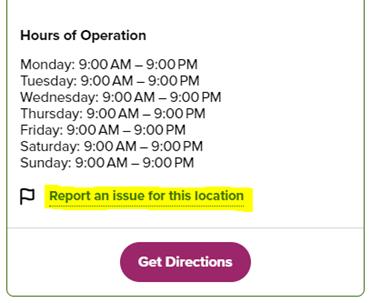
If the request is for multiple locations, contact the Compliance Team at [email protected] with the following information:
- the issue,
- name and address for each collection site, and
- your contact information.
Posted on October 30, 2024 by Michelle Hoover -
To delete a duplicate collection site, submit a request through the map directly by:
- looking up the location,
- clicking the location,
- clicking the ‘Report an issue for this location’ link, and
- filling out the form by asking to remove the duplicate collection site.
If the request is for multiple locations, contact the Compliance Team at [email protected] with the following information:
- the issue,
- name and address for each collection site, and
- your contact information.
Posted on October 30, 2024 by Michelle Hoover -
Municipalities are required to accept materials from the sectors identified in their Environmental Compliance Approval (ECA). Municipalities are not required to accept more than what their ECA requires them to.
Posted on October 30, 2024 by Michelle Hoover -
If your collection site isn’t part of a PRO’s collection network, it won’t appear on the map. The map populates collection sites with data entered by producers or PROs on their behalf.
If you are working with a PRO and your site is not listed on the map, contact your PRO.
If you aren’t already working with a PRO and want to add your collection site to the map, you can find a list of PROs and their contact information on the applicable program page of RPRA’s website.