




Frequently Asked Questions
Results (29)
Click the question to read the answer.
-
When paying fees to RPRA, you can select from one of the following payment methods:
- Direct debit (also known as bank withdrawal)
- Credit card
- Electronic data interchange (EDI; also commonly known as ACH or EFT)
- Electronic bill payment
- Cheque
For instructions on how to submit payment by the method you chose, read one of the following FAQs:
- How do I pay my fees to RPRA by credit card?
- How do I pay my fees to RPRA by direct debit?
- How do I pay my fees to RPRA by electronic bill payment?
- How do I pay my fees to RPRA by cheque?
- How do I pay my fees to RPRA by electronic data interchange (EDI)?
Please note:
- Invoices are due on receipt.
- Invoices are in CAD fund and payments must be sent in CAD.
-
We recommend using Google Chrome, Mozilla Firefox, Microsoft Edge or Apple Safari when accessing the Registry. If you are experiencing an issue with the Registry, try clearing your cache or updating the browser to the latest version.
If you are using a different browser, the Registry will not function.
-
Program fees are charges that producers obligated under the Resource Recovery and Circular Economy Act, 2016, are required to pay to RPRA annually to recover its operational costs, including costs related to building and operating the registry, providing services to registrants, and compliance and enforcement activities.
All current and past fee schedules can be found here.
-
To create a Registry account with RPRA, you will need to provide:
- CRA Business Number (BN)
- Legal Business Name
- Business address and phone number
- Address of where you work (if different from the main office)
- Contact information for your billing contact (this may also be added later)
-
For regulatory purposes, we need to know your legal name — the name you are incorporated under. We also need to know your business operating name if it is different from your legal business name to add to our published list of registrants. The list of registrants will be available on our website to allow registrants to interact with one another and to provide information to the public.
-
As the Regulator responsible for enforcing regulations under the Resource Recovery and Circular Economy Act, 2016, the Registrar uses their discretion for when it is necessary to give registrants more time to collect the information needed for registration and/or reporting.
-
See our FAQ to understand “What is blue box product packaging?”.
Product packaging added to a product can be added at any stage of the production, distribution and supply of the product. A person adds packaging to a product if they:
- make the packaging available for another person to add the packaging to the product
- cause another person to add the packaging to a product
- combine the product and the packaging
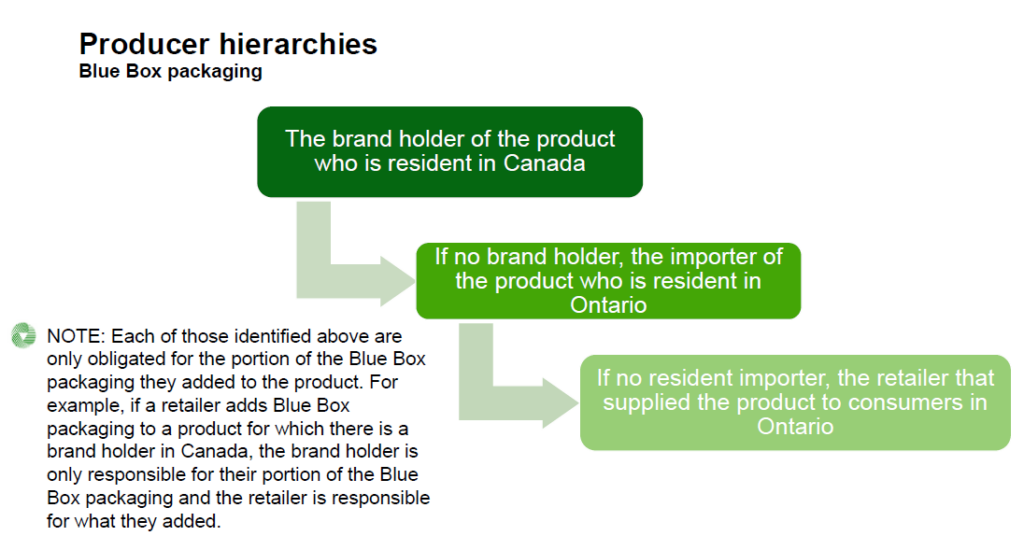
For the portion of the product packaging that a brand holder added to the product, a person is considered a producer:
- if they are the brand holder of the product and are resident in Canada
- if no resident brand holder, they are resident in Ontario and import the product from outside of Ontario
- if no resident importer, they are the retailer that supplied the product directly to consumers in Ontario
- if the retailer who would be the producer is a marketplace seller, the marketplace facilitator is the obligated producer
- if the producer is a business that is a franchise, the franchisor is the obligated producer, if that franchisor has franchisees that are resident in Ontario
For the portion of the product packaging that an importer of the product into Ontario added to the product, a person is considered a producer:
- if they are resident in Ontario and import the product from outside of Ontario
- if no resident importer, they are the retailer that supplied the product directly to consumers in Ontario
- if the retailer who would be the producer is a marketplace seller, the marketplace facilitator is the obligated producer
- if the producer is a business that is a franchise, the franchisor is the obligated producer, if that franchisor has franchisees that are resident in Ontario
For any portion of the packaging that is not described above, the producer is the retailer who supplied the product to consumers in Ontario.
-
See our FAQs to understand “What are paper products?” and “What are packaging-like products?”.
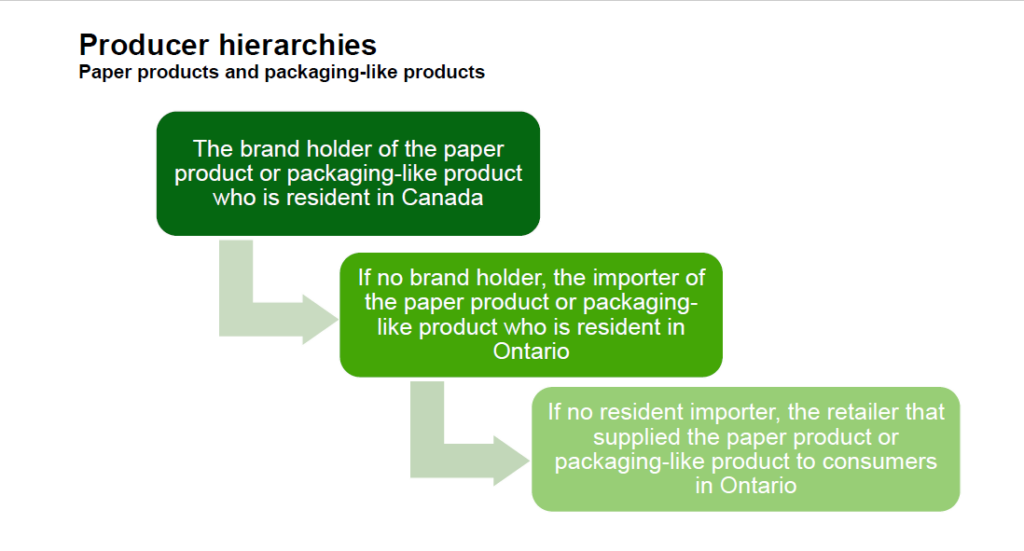
For paper products and packaging-like products, a person is considered a producer:
- if they are the brand holder of the paper product or packaging-like product and are resident in Canada
- if no resident brand holder, they are resident in Ontario and import the paper product or packaging-like product from outside of Ontario
- if no resident importer, they are the retailer that supplied the paper product or packaging-like product directly to consumers in Ontario
- if the retailer who would be the producer is a marketplace seller, the marketplace facilitator is the obligated producer
- if the producer is a business that is a franchise, the franchisor is the obligated producer, if that franchisor has franchisees that are resident in Ontario
-
The brand holder is the obligated producer.
A marketplace facilitator only becomes obligated for products supplied through its marketplace where the producer would have been a retailer. If the producer is a brand holder or an importer, they remain the obligated producer even when products are distributed by a marketplace facilitator.
A retailer is a business that supplies products to consumers, whether online or at a physical location.
-
Blue Box materials supplied to the IC&I sector are not obligated, therefore, deductions are available for materials supplied to a consumer in an IC&I setting.
Blue Box producers may deduct materials that are collected from a business or institution where producers are not required to provide Blue Box collection services. Examples include:
- Offices
- Stores and shopping malls
- Restaurants
- Hotels
- Hospitals
- Community centres
- Places of worship
- Recreation facilities
- Sports and entertainment venues
- Universities and colleges
- Manufacturing facilities
- Golf courses
- Cemeteries
- Amusement parks
Producers are responsible for material collected from eligible sources in the producer run Common Collection System, Alternative or Supplemental Collections Systems. Material from these categories is not allowed to be deducted:
- Material that is collected from a residence through a curbside or depot collection service.
- Material that is generated at a facility (including multi-residential buildings, retirement homes, long-term care homes and schools).
- Material that is collected from a public space (including an outdoor area in a park, playground or sidewalk, or a public transit station).
- Material collected under an alternative or supplemental collection system.
Please see the Reporting Guidance Ineligible Source Deductions for the 2026 Blue Box Supply Report for more information on how to determine and use these deductions.
Also see our FAQs: ‘What deductions are available to producers under the Blue Box Regulation?’, ‘Who is a consumer under the Blue Box Regulation’
-
RPRA does not vet PROs before listing them on the website. Any business that registers as a PRO will be listed. Producers should do their own due diligence when determining which PRO to work with.
-
First Nation communities interested in receiving producer-run Blue Box services must register with the Authority. To register, communities must submit contact information of the person responsible for waste management in the community using the First Nation community registration form. Once completed, the registration form should be submitted by email to [email protected].
Visit our First Nation webpage for more information.
-
Producers are required to register with RPRA within 30 days of supplying obligated Blue Box material into Ontario.
-
Producers are required to provide the following information when registering with RPRA:
- Contact information
- PRO information (if a PRO has been retained at time of reporting), including what services they have retained a PRO for
- Their supply data from the previous calendar year in each of the seven material categories – beverage container, glass material, flexible plastic, metal material, paper material, and certified compostable products and packaging material – as well as any deductions.
Please note that this information must be submitted to RPRA directly.
See our FAQ to understand “What deductions are available to producers under the Blue Box Regulation?”
-
Yes, a producer can change PROs at any time. Producers must notify RPRA of any change in PROs within 30 days of the change.
-
Account admins must add any new, or manage existing, contacts under the program they wish to give them access to in order for the contact to be able to submit a report or pay an invoice. The account admins are the only user than can add a Primary Contact and an Accounts Payable User to a Registry Account.
To Manage contacts on your Registry account, please see the following steps:
- Log into your account.
- Once you are logged in, click on the drop-down arrow in the top right corner and select Manage Users.
- Under Actions, click Edit to update preferences of existing user primary and secondary users.
- Click Add New User to add an additional contact to your account.
- To give reporting access to a Primary Contact, select the program from the drop-down that you would like to grant them access to.
- Click “Set Accounts Payable User” to add an AP contact to your account.
-
No, only producers are required to pay RPRA program fees. The decision to make producers pay fees and cover RPRA’s costs was made to reflect the fact that the Resource Recovery and Circular Economy Act, 2016 (RRCEA) is based on a producer responsibility framework. Although producers may hire service providers to help meet their obligations, the responsibility remains with the producer.
-
Processors need to provide the following information when registering with the Authority:
- Business information (e.g., business name, contact information)
- Processing site location, contact information and Blue Box materials received and processed at each location
- Any producers or PROs the processor has contracted with
Visit our Blue Box Processors webpage for more information.
-
No. If your business does not conduct resource recovery activities as its primary purpose, there is no requirement to register as a processor with the Authority.
-
RPRA considers an aerosol container to be a non-refillable receptacle that contains a product and a propellant under pressure, and that is fitted with a release device allowing the contents to be ejected as solid or liquid particles in suspension in a gas, or as a foam, paste, powder, liquid, or gas.
-
Free riders are obligated parties that:
- Have not registered or reported to RPRA
- Have not established a collection and management system (if they are so required to), or;
- Are not operating a collection and management system (if they are so required to).
See our FAQs to understand “What is RPRA’s approach to free riders?”, and “What do I do if I think a business is a free rider?”
To note:
- Some producers only have requirements to register and report. Please refer to your specific program page on our website to understand producer obligations.
- Collection and management systems may be accomplished by a producer responsibility organization (PRO) on behalf of a producer through contractual arrangements between the producer and PRO. If a PRO is managing a producer’s collection and management requirements, producers must identify that PRO to RPRA.
-
For the purpose of reporting annual supply data under the Blue Box Regulation, the weight of newspaper must be reported in the appropriate material categories. For example, newsprint must be reported in the ‘paper’ category, while any protective plastic wrapping must be reported as ‘flexible plastic’.
Then, producers will be asked to indicate what percentage of their total Blue Box material supply was newspaper, including any protective wrapping and supplemental advertisements and inserts, in that calendar year.
See our FAQs: “What is a newspaper?” and “Who is a newspaper producer?”
-
If you select credit card as your method of payment, this will be done through your Registry account.
Follow these steps to complete your payment:
Follow these steps to complete your payment:
- In the payment method section of the Registry, select credit card as your preferred method.
- Enter your credit card details.
- Click PAY and the payment will process automatically.
Please note:
- Invoices are due on receipt.
- Invoices are in CAD funds and payments must be sent in CAD.
- Payment will be reflected in your Registry account once your transaction has been processed.
- Registrants can save a credit card as their preferred payment method.
- Hazardous Waste Program (HWP) registrants can enrol in Manifest Autopay with credit card as their saved payment method.
If you have questions about fee payment, contact our Compliance and Registry Team at [email protected] or call 1-833-600-0530.
How do I pay my fees to RPRA by cheque?
If you select cheque as your method of payment, follow these steps to complete your payment:
- Make your cheque payable to “Resource Productivity and Recovery Authority”
- Enter your Invoice Number on the memo line of the cheque
- Send your cheque to:
- Resource Productivity Recovery Authority
- PO Box 46114, STN A
- Toronto, ON
- M5W 4K9
Please note:
- Invoices are due on receipt.
- Invoices are in CAD funds and payments must be sent in CAD.
- It may take 2-4 weeks for your payment to be reflected in your Registry account due to mail and cheque processing times.
If you have questions relating to fee payment, contact our Compliance and Registry Team at [email protected] or call 1-833-600-0530.
-
If you select direct debit (also known as bank withdrawal) as your method of payment, this will be done through your Registry account.
Follow these steps to complete your payment:
- In the payment method section of the Registry, select direct debit as your preferred method.
- Enter your banking information/details.
- Review the withdrawal agreement then click “I agree to let RPRA collect my payments as per the terms of the Withdrawal Agreement.”
- Click PAY and the payment will process automatically.
Please note:
- Invoices are due on receipt.
- Invoices are in CAD funds and payments must be sent in CAD.
- Payment will be reflected in your Registry account once your transaction has been processed.
- By selecting direct debit, registrants authorize RPRA to collect payments as outlined in the withdrawal agreement.
- Registrants can save direct debit as their preferred payment method.
- Hazardous Waste Program (HWP) registrants can enrol in Manifest Autopay with direct debit as their saved payment method.
If you have questions about fee payment, contact our Compliance and Registry Team at [email protected] or call 1-833-600-0530.
-
If you select electronic bill payment as your method of payment, this will be done through your online banking account, using the bill payment functionality. It is available at most major Canadian banks (e.g., TD, RBC, BMO, Scotiabank).
Follow these steps to complete your payment:
- Log in to your bank account.
- Go to the bill payment section and add RPRA as payee.
- Enter your registration number (found on your invoice) as the account number.
Please note:
- Invoices are due on receipt.
- Invoices are in CAD funds and payments must be sent in CAD.
- It may take 1–2 weeks for payment to be reflected in your Registry account.
If you have questions relating to fee payment, contact our Compliance and Registry Team at [email protected] or call 647-496-0530 or toll-free at 1-833-600-0530.
-
If you select cheque as your method of payment, follow these steps to complete your payment:
- Make your cheque payable to “Resource Productivity and Recovery Authority”
- Enter your Invoice Number on the memo line of the cheque
- Send your cheque to:
- Resource Productivity Recovery Authority
- PO Box 46114, STN A
- Toronto, ON
- M5W 4K9
Please note:
- Invoices are due on receipt.
- Invoices are in CAD funds and payments must be sent in CAD.
- It may take 2-4 weeks for your payment to be reflected in your Registry account due to mail and cheque processing times.
If you have questions relating to fee payment, contact our Compliance and Registry Team at [email protected] or call 1-833-600-0530.
-
If you select electronic data interchange (EDI) as your method of payment, this is an electronic payment through your bank, also commonly known as EFT or ACH.
Follow these steps to complete your payment:
- Submit your payment using RPRA’s banking information provided on your invoice.
- Reference your invoice number when you submit this payment to your bank so RPRA can identify your payment and send your remittance details to [email protected]
Please note:
- Invoices are due on receipt.
- Invoices are in CAD funds and payments must be sent in CAD.
- It may take 1-2 weeks for payment to be reflected in your Registry account.
If you have questions relating to fee payment, contact our Compliance and Registry Team at [email protected] or call 647-496-0530 or toll-free at 1-833-600-0530.
-
No. Effective February 6, 2023, RPRA will no longer accept requests for extensions to registration or reporting deadlines. Obligated parties should make every effort to ensure they meet all submission deadlines as part of their obligations under their associated regulation.
For more guidance, read the Late Registration or Report Submissions Compliance Bulletin.
-
Producers are obligated parties under the Resource Recovery and Circular Economy Act and are ultimately responsible for their data submitted through RPRA’s Registry. Producers can choose to contract with an external consultant to support their data submission, but third parties have limited permissions in the Registry as they are not regulated parties.
A producer can choose to assign a primary or secondary user profile in their Registry account to an external consultant. An external consultant may submit supply data reports and/or pay registry fees on the producer’s behalf.
External consultants cannot submit and/or sign registration, executive attestations, account admin changes or supply data adjustment documentation on behalf of a producer. External consultants cannot be account admins, nor can they manage a PRO within the Registry on behalf of a producer.