


Frequently Asked Questions
Results (45)
Click the question to read the answer.
-
Here are the lists of registered PROs:
Hazardous and Special Products PROs
These lists will continue to be updated as new PROs register with RPRA.
-
If you are a First Nation, municipality, retailer or organization that collects tires whether through a depot, collection events or on-site collection containers, you are considered a tire collection site operator. However, you are not required to facilitate collection services, register or report as a tire collector under the Tires Regulation.
If First Nation communities, municipalities or other collection site operators want to collect used tires as a service to customers or residents, they need to ensure their sites are included in a collection network and should contact a service provider registered with RPRA. View the list of registered tire service providers here.
See our FAQ: “I operate a tire collection site. Who will pick up my tires?”
-
Yes. PROs are private enterprises and charge for their services to producers.
Each commercial contract a producer enters with a PRO will have its own set of terms and conditions. It is up to the PRO and producer to determine the terms of their contractual agreement, including fees and payment schedule.
RPRA does not set the terms of the contractual arrangements between PROs and producers.
-
No, producers are not required to sign up with a PRO to meet their regulatory requirements. It is a business decision if a producer chooses to work with a PRO, and a producer can choose to meet their obligations without a PRO.
Most producers will choose to contract with a PRO to provide collection, hauling, processing, retreading and/or refurbishing services to achieve their collection and management requirements unless they carry out these activities themselves.
-
Yes. Producers and service providers can enter into contractual agreements with multiple PROs.
-
No. The Resource Recovery and Circular Economy Act, 2016 states that a person responsible for establishing and operating a collection system shall ensure that no charge is imposed at the time of the collection.
If a consumer is charged a fee, they can report it to RPRA at [email protected].
-
As of 2025 onwards, producers no longer have collection targets and are not required to collect a minimum weight of used tires.
A producer’s individual management target is determined using the formulas below:
Management targets for all tires
Performance year Supply report year Formula 2025 2024 [(2020 supply + 2021 supply + 2022 supply) / 3)]×65% *2026 2025 [(2021 supply + 2022 supply + 2023 supply) / 3)]×80% 2027 2026 [(2022 supply + 2023 supply + 2024 supply) / 3)]×80% 2028 2027 [(2023 supply + 2024 supply + 2025 supply) / 3)]×80% *The regulation was amended in September 2026, and an in-year change of the management target for 2026 has increased from 65% to 80%.
Management targets for large tires
Performance year Supply report year Formula 2025 2024 [(2020 supply + 2021 supply + 2022 supply) / 3)]×60% 2026 2025 [(2021 supply + 2022 supply + 2023 supply) / 3)]×60% 2027 2026 [(2022 supply + 2023 supply + 2024 supply) / 3)]×60% 2028 2027 [(2023 supply + 2024 supply + 2025 supply) / 3)]×60% 2029 2028 [(2024 supply + 2025 supply + 2026 supply) / 3)]×60% 2030 2029 [(2025 supply + 2026 supply + 2027 supply) / 3)]×60% Note: A producer who has an average weight of supply for a calendar year of less than 1,175 kg, may be exempt from registering with and reporting to RPRA. See our FAQ ‘How do I determine if I am an exempt tire producer?’ to learn more.
-
The Tires Regulation states that at least one collection site or event per year is required in a territorial district with a population of 1,000 or more. Read Compliance Bulletin – Tire Collection Systems for more information.
-
If a municipality chooses not to operate any tire collection sites, residents can be directed to a registered collector.
Contact RPRA’s Compliance and Registry Team at [email protected], 647-496-0530 or toll free at 1-833-600-0530 if you or your residents have any issues dropping off less than 10 tires to a registered collector’s site.
-
Contact the Ministry of Environment, Conservation and Parks for any information about Environmental Compliance Approvals.
-
If you collect used tires at your site as a result of onsite servicing of your vehicles, you are not a tire collector for the purposes of the Tires Regulation. These collection sites are considered private collection sites and may be used to achieve management requirements but cannot be used to meet the requirements of a public collection system (e.g., site is not open to the public for tire drop-offs).
-
Operators of tire collection sites will have to independently enter into commercial agreements with producers or producer responsibility organizations (PROs) to secure tire collection services. As long as a collection site is part of a producer’s tire collection system, the producer, or their PRO, is obligated to ensure tires are picked up from that site.
Since producers have legal obligations under the Tires Regulation, producers, or their PROs, will need tires to meet their management requirements. While tire collectors (i.e., operator of collection sits) are no longer required to register with RPRA, the collection site must be part of a producer’s collection system for the tires to count toward a producer’s management requirements
A list of registered PROs and producers is available on RPRA’s website on the Find a registrant page.
-
Producers have the choice of establishing and operating their own collection and management systems or working with one or more producer responsibility organizations (PROs) registered with RPRA to meet their obligations.
Most producers will work with a PRO to meet their requirements, including performance reporting.
If you have not yet contracted with a PRO, it is important that you do so as soon as possible to ensure that you can meet your obligations. In order for a PRO to report on your behalf, you must identify them in RPRA’s Registry. Learn more about PROs here.
For more guidance, read the Tire Collection System Compliance Bulletin.
-
No. If a municipality has a private company operating a site on their behalf, the company is not required to register the municipally-owned sites as long as the tires are picked up by a registered hauler and delivered to a registered processor or retreader.
If the private company owns or operates collection sites that are not owned by a municipality, it is required to register and report its non-municipally-owned sites.
To ensure tires continue to be picked up from your sites, you will need to make sure those sites are included in the collection systems established by tire producers or producer responsibility organizations (PROs). Since most producers will work with PROs to establish their collection systems, municipalities should contact a registered PRO.
Visit our webpage about PROs for more information.
-
A producer responsibility organization (PRO) is not necessarily required to include each and every collection site in Ontario in their collection system. However, producers and PROs acting on their behalf are required to establish and operate a collection system that meets the requirements of the Tires Regulation.
If a collection site operator is unable to be included in a collection system, the operator should contact RPRA’s Compliance Team at [email protected], 647-496-0530 or toll free at 1-833-600-0530 for assistance.
Read Compliance Bulletin – Tire Collection Systems for more information. The contact information for all registered PROs is available on the producer responsibility organization webpage.
-
A producer responsibility organization (PRO) is a person retained by a producer for the purpose of carrying out one or more of the following producer regulatory responsibilities:
- Arranging for the establishment or operation of collection or management systems
- Establishing or operating a collection or management system
- Preparing and submitting reports
In addition, under the Hazardous and Special Products regulation, a PRO includes a person retained by a producer for the purpose of:
- Implementing a promotion and education program
PROs operate in a competitive market, and producers can choose the PRO (or PROs) they want to work with. The terms and conditions of each contract with a PRO may vary.
How do I find a PRO?
Here are the lists of registered PROs:
These lists will continue to be updated as new PROs register with RPRA.
See our FAQ What is the difference between a PRO and a prospective PRO?
-
Collection sites are required to accept used tires that are of similar rim size and weight as the new tires (or tires on new vehicles) that they sell.
Use the Where to Recycle Map to find a drop-off location in Ontario for your used tires.
-
No. RPRA does not administer contracts or provide incentives. Under the Regulations, producers will either work with a producer responsibility organization (PRO) or work directly with collection sites, haulers, refurbisher’s and/or processors to meet their collection and management requirements. Any reimbursement for services provided towards meeting a producers’ collection and management requirements will be determined through commercial contracts.
To discuss any payment, contact your service provider or a PRO. RPRA does not set the terms of the contractual arrangements between PROs and producers.
-
Tire collection sites are established to facilitate the responsible recycling and management of used tires. The types of tires accepted at these sites include, but are not limited to:
Examples of Accepted Tires:
- Automobile tires (cars, SUVs, light-duty trucks)
- Motorcycle tires
- Motor assisted bicycle tires (e.g., mopeds, non-kick scooters)
- Tractor tires
- Tires on industrial and agricultural vehicles and equipment
- Transport truck tires
- Trailer tires (e.g., boat trailers, RVs)
- All-terrain vehicle (ATV) tires
- Riding lawn mower tires
- Aircraft tires (if not supplied on an aircraft)
- Snow blower tires
- Small tires (1 kg to <5 kg), such as:
- Wheelbarrow tires
- Dolly tires
Examples of Tires That Are Not Accepted:
- Bicycle tires (muscle-powered)
- Stroller and kick scooter tires (non-motorized)
- Power-assisted bicycle tires (e.g., electric bicycles)
- Personal mobility device tires (e.g., wheelchairs, medical scooters)
Tires can be dropped off on or off the rim. Collection sites must accept tires on rims.
-
Yes, a producer, a PRO (producer responsibility organization) on behalf of a producer, or a service provider on behalf of either party, can collect any product or material (including materials or products that are not designated under the Resource Recovery and Circular Economy Act, 2016 (RRCEA)). For example, a battery producer may choose to collect batteries that weigh over 5kg; a tire producer may choose to collect bicycle tires; or a Blue Box producer may choose to collect books.
Products or materials that are not designated under RRCEA regulations cannot be counted towards meeting a producer’s collection or management requirements under RRCEA.
If designated materials are co-collected with materials that are not designated, a person must use a methodology or process acceptable to the Authority to account for those materials. Anyone considering this can contact the Compliance Team to discuss at [email protected] or 833-600-0530.
For example, if bicycle tires are collected at the same time as automotive tires, they must be accounted for separately both when collected and when sent to a processor.
-
No. Recycling drop-off locations displayed on the map cannot:
- charge the public a fee to drop off materials that the location accepts.
- refuse the drop-off of materials displayed on the map. However, recycling locations can request reasonable requirements when consumers drop off an item to ensure health and safety. For example, sites may require that used oil filters are dropped off in sealed containers, light tubes are taped together, etc.
If you are charged a fee or refused drop off, you can report an issue about that specific location to RPRA (see our other FAQ for further instructions).
Note: In October 2026, the Where to Recycle map moved from rpra.ca to OntarioRecycles.ca, RPRA’s website to keep the public informed about the circular economy and recycling in Ontario.
-
RPRA’s Where to Recycle map displays locations across Ontario where the public can drop off used materials to be recycled, such as batteries, electronics, household hazardous waste (e.g., paint, antifreeze, pesticides), lighting and tires, for free. Materials collected at these locations are reused, refurbished, recycled, or properly disposed of to help keep them out of landfill, recover valuable resources and protect our environment.
Note: In October 2026, the Where to Recycle map moved from rpra.ca to OntarioRecycles.ca, RPRA’s website to keep the public informed about the circular economy and recycling in Ontario.
-
The recycling locations that appear on the map are reported to RPRA by businesses that run the recycling systems in Ontario.
-
A collection site is required to:
- accept all used materials that are designated under the program the collection site operates under*,
- accept materials dropped off free of charge, and
- accept materials dropped off during regular business hours.
The amount and type of materials a collection site must accept varies by which program they operate under.
*More information on what materials must be accepted for each recycling program can be found here.
Note: In October 2026, the Where to Recycle map moved from rpra.ca to OntarioRecycles.ca, RPRA’s website to keep the public informed about the circular economy and recycling in Ontario.
-
Collection sites for batteries, electronics, household hazardous waste, lighting, and tires that are reported by producers, or PROs on their behalf, appear on the map.
Collection sites that are considered private (e.g. a recycling bin inside a business that is not accessible to the public) do not appear on the map.
Note: In October 2026, the Where to Recycle map moved from rpra.ca to OntarioRecycles.ca, RPRA’s website to keep the public informed about the circular economy and recycling in Ontario.
-
Collection site names are taken from Google Maps. If the name is wrong, request to change it through the map directly by:
- looking up the location,
- clicking the location,
- clicking the ‘Report an issue for this location’ link, and
- filling out the form by providing the correct name.
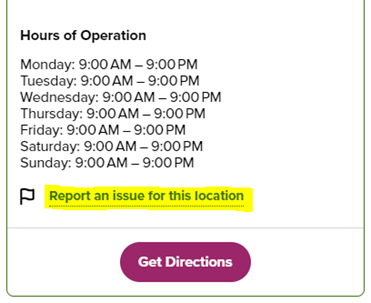
Note: In October 2026, the Where to Recycle map moved from rpra.ca to OntarioRecycles.ca, RPRA’s website to keep the public informed about the circular economy and recycling in Ontario.
-
Only your PRO can update collection site addresses. Ask your PRO to remove the old address from their collection network and add the new address.
The Compliance Team is unable to make changes to the address of a site that has been reported.
Note: In October 2026, the Where to Recycle map moved from rpra.ca to OntarioRecycles.ca, RPRA’s website to keep the public informed about the circular economy and recycling in Ontario.
-
Business hours are taken from Google Maps. If the information on Google Maps is incorrect, update your Google account information by following these steps. Note: there may be a delay between the time you update your information in Google and it showing on RPRA’s map.
If the information on Google Maps is correct and not showing on the Where to Recycle map, request to change it through the map directly by:
- looking up the location,
- clicking the location,
- clicking the ‘Report an issue for this location’ link, and
- filling out the form by providing the correct business hours.
Note: In October 2026, the Where to Recycle map moved from rpra.ca to OntarioRecycles.ca, RPRA’s website to keep the public informed about the circular economy and recycling in Ontario.
-
Phone numbers are taken from Google Maps. If the information on Google Maps is incorrect, update your Google account information by following these steps. Note: there may be a delay between the time you update your information in Google and it showing on RPRA’s map.
If the information on Google Maps is correct and not showing on the Where to Recycle map, request to change it through the map directly by:
- looking up the location,
- clicking the location,
- clicking the ‘Report an issue for this location’ link, and
- filling out the form by providing the correct phone number.
Note: In October 2026, the Where to Recycle map moved from rpra.ca to OntarioRecycles.ca, RPRA’s website to keep the public informed about the circular economy and recycling in Ontario.
-
Websites are taken from Google Maps. If the information on Google Maps is incorrect, update your Google account information by following these steps. Note: there may be a delay between the time you update your information in Google and it showing on RPRA’s map.
If the information on Google Maps is correct and not showing on the Where to Recycle map, request to change it through the map directly by:
- looking up the location,
- clicking the location,
- clicking the ‘Report an issue for this location’ link, and
- filling out the form by providing the correct website link.
Note: In October 2026, the Where to Recycle map moved from rpra.ca to OntarioRecycles.ca, RPRA’s website to keep the public informed about the circular economy and recycling in Ontario.
-
Wrong materials showing
If your site doesn’t collect the material(s) listed on the map, you can submit a request to change it through the map directly by:
- looking up the location,
- clicking the location,
- clicking the ‘Report an issue for this location’ link, and
- filling out the form by providing which materials should be removed.
Materials not showing
If you collect more materials than what is listed on the map, contact your PRO and they’ll update your collection site information.
If you aren’t already working with a PRO for a specific material and want to add a material to your collection site, you can find a list of PROs and contact information on the applicable program page of RPRA’s website.
Note: In October 2026, the Where to Recycle map moved from rpra.ca to OntarioRecycles.ca, RPRA’s website to keep the public informed about the circular economy and recycling in Ontario.
-
First, contact your PRO to confirm if the collection site should be considered private or if it can be removed entirely from their collection system. If they confirm it can be removed from the system, ask them to deactivate it so it no longer appears on the map.
If you aren’t working with a PRO, request to remove your collection site through the Where to Recycle map directly by:
- looking up the location,
- clicking the location,
- clicking the ‘Report an issue for this location’ link, and
- filling out the form asking to remove the collection site.
Note: In October 2026, the Where to Recycle map moved from rpra.ca to OntarioRecycles.ca, RPRA’s website to keep the public informed about the circular economy and recycling in Ontario.
-
A public collection site must be readily accessible to the public and accept designated used materials during regular business hours. Publicly accessible collection sites and events appear on the Where to Recycle map. Note: In October 2026, the Where to Recycle map moved from rpra.ca to OntarioRecycles.ca, RPRA’s website to keep the public informed about the circular economy and recycling in Ontario.
A private collection site (e.g. office or school that collects designated materials) does not need to be publicly accessible. Private collection sites do not appear on the map.
Read this related FAQ: What does it mean for a collection site to be readily accessible to the public?
-
If your collection site isn’t part of a PRO’s collection network, it won’t appear on the Where to Recycle map. The map populates collection sites with data entered by producers or PROs on their behalf.
If you are working with a PRO and your site is not listed on the map, contact your PRO.
If you aren’t already working with a PRO and want to add your collection site to the map, you can find a list of PROs and their contact information on the applicable program page of RPRA’s website.
Note: In October 2026, the Where to Recycle map moved from rpra.ca to OntarioRecycles.ca, RPRA’s website to keep the public informed about the circular economy and recycling in Ontario.
-
Municipalities are required to accept materials from the sectors identified in their Environmental Compliance Approval (ECA). Municipalities are not required to accept more than what their ECA requires them to.
-
To delete a duplicate collection site, submit a request through the Where to Recycle map directly by:
- looking up the location,
- clicking the location,
- clicking the ‘Report an issue for this location’ link, and
- filling out the form by asking to remove the duplicate collection site.
If the request is for multiple locations, contact the Compliance Team at [email protected] with the following information:
- the issue,
- name and address for each collection site, and
- your contact information.
Note: In October 2026, the Where to Recycle map moved from rpra.ca to OntarioRecycles.ca, RPRA’s website to keep the public informed about the circular economy and recycling in Ontario.
-
To update the type of collection site, submit a request through the Where to Recycle map directly by:
- looking up the location,
- clicking the location,
- clicking the ‘Report an issue for this location’ link, and
- filling out the form by providing the correct collection site type.
If the request is for multiple locations, contact the Compliance Team at [email protected] with the following information:
- the issue,
- name and address for each collection site, and
- your contact information.
Note: In October 2026, the Where to Recycle map moved from rpra.ca to OntarioRecycles.ca, RPRA’s website to keep the public informed about the circular economy and recycling in Ontario.
-
Battery, electronics, lighting and tire collection sites must be operated during regular business hours throughout the calendar year.
Household hazardous waste collection sites may open seasonally. The Where to Recycle map should reflect the time of the year when the collection site operates.
Note: In October 2026, the Where to Recycle map moved from rpra.ca to OntarioRecycles.ca, RPRA’s website to keep the public informed about the circular economy and recycling in Ontario.
-
Readily accessible to the public means a site can be accessed by any consumer who wants to drop off used materials for free to be recycled, reused or refurbished.
A public collection site cannot restrict the type of products accepted. For example, an electronics collection site cannot refuse to accept printers or large televisions. Retail stores are only required to accept materials of a similar size and function to the products supplied at that location. For example, a mobile phone kiosk may choose to accept only mobile phones.
Collection sites can request reasonable requirements when consumers drop off an item to ensure health and safety. For example, sites may require that used oil filters are dropped off in sealed containers, light tubes are taped together, etc.
Publicly accessible collection sites and events will appear on the Where to Recycle map. Note: In October 2026, the Where to Recycle map moved from rpra.ca to OntarioRecycles.ca, RPRA’s website to keep the public informed about the circular economy and recycling in Ontario.
Restrictions
If a collection site has restrictions, for example due to an Environmental Compliance Approval (ECA), municipal by-law, or fire code provision, the restrictions may be applied, and the collection site will still be considered readily accessible to the public. For example, a municipal depot that has an ECA to accept materials only from residents of the community can apply this restriction and still be considered readily accessible to the public. Similarly, a collection site with an ECA that prohibits collection from the industrial, commercial and institutional sectors may apply these restrictions and still be considered readily accessible to the public. And a collection site that has restrictions on how it can be accessed (such as drive-in only) may enforce these restrictions and still be considered readily accessible to the public.
Read this related FAQ: What is the difference between a public and private collection site?
-
A producer responsibility organization (PRO) is a person retained by a producer to provide collection, management and administrative services to help producers meet their regulatory obligations.
A prospective PRO is a person that has registered with RPRA but have not been identified by a producer in RPRA’s registry to carry out regulatory responsibilities.
More information on PROs
PRO responsibilities include:
- Arranging for the establishment or operation of collection or management systems
- Establishing or operating a collection or management system
- Preparing and submitting reports
In addition, under the Hazardous and Special Products regulation, a PRO includes a person retained by a producer for the purpose of:
- Implementing a promotion and education program
Only PROs that meet this definition will:
- Be listed on RPRA’s website as a PRO
- Be invited to attend all-PRO meetings with RPRA
- Receive system-wide compliance communications
More information on prospective PRO
RPRA will list all prospective PROs on its website for up to one year. After that period, prospective PROs that remain unassigned by a producer in the registry will be notified, removed from the website, and have their registry account deactivated.
RPRA will publish a list of producers who have not yet identified a PRO in the registry. This will help prospective PROs understand where opportunities may exist.
-
As of October 2026, the Where to Recycle map moved from rpra.ca to OntarioRecycles.ca, RPRA’s new website to keep the public informed about the circular economy and recycling in Ontario.
This change supports RPRA’s mandate of making information about resource recovery and waste reduction in Ontario accessible to the public.
For convenience, there are links throughout this website directing users to the map on Ontario Recycles. Learn more about Ontario Recycles here.
-
“Northern Ontario” is defined in the Territorial Division Act, 2002 and includes municipalities and territorial districts located within the following geographic areas:
- Algoma
- Cochrane
- Kenora
- Manitoulin
- Nipissing
- Parry Sound
- Rainy River
- Sudbury
- Thunder Bay
- Timiskaming
Large producers and producers without retail locations are required to establish and operate at least 220 collection sites (10%) within these communities, beyond the required number determined by population. More information can be found in the Tire Collection Systems Compliance Bulletin.
-
No. Tire producers and PROs working on their behalf must operate the collection system and management system they have established even after their management targets are met.
Once a management target is met, producers and PROs working on their behalf must continue to manage those tires even if they are not counted towards resource recovery.
-
A retailer may charge a tire recycling fee on new tires sold to consumers to recover the costs of recycling tires. RPRA does not mandate that businesses charge recycling fees, nor does it set the amount of the fee to be charged.
However, if a retailer is included in a producer’s public collection network the retailer (e.g., public recycling location), cannot charge a fee or refuse the drop-off of materials that the location accepts when a consumer drops off a used tire at the end of its life.
If a retailer is not included in a producer’s public collection network, they have no obligation to accept used tires.
Review our other FAQs on environmental fees for more information.
-
No. A producer or PRO is not required to include every collection site in Ontario in its public collection system.
Starting in 2027, if a collection site is included in a producer’s or PRO’s collection network and is used to meet a producer’s collection system requirement, it will be reported to RPRA.
There are restrictions on when a collection site can be replaced during a calendar year. A reported collection site may be substituted if the site is closing its operations or if the collection site owner no longer wants to be part of that producer’s or PROs collection system.
More information can be found in the Tire Collection Systems Compliance Bulletin.