




Frequently Asked Questions
Results (253)
Click the question to read the answer.
-
A producer responsibility organization (PRO) is a person retained by a producer to provide collection, management and administrative services to help producers meet their regulatory obligations.
A prospective PRO is a person that has registered with RPRA but have not been identified by a producer in RPRA’s registry to carry out regulatory responsibilities.
More information on PROs
PRO responsibilities include:
- Arranging for the establishment or operation of collection or management systems
- Establishing or operating a collection or management system
- Preparing and submitting reports
In addition, under the Hazardous and Special Products regulation, a PRO includes a person retained by a producer for the purpose of:
- Implementing a promotion and education program
Only PROs that meet this definition will:
- Be listed on RPRA’s website as a PRO
- Be invited to attend all-PRO meetings with RPRA
- Receive system-wide compliance communications
More information on prospective PRO
RPRA will list all prospective PROs on its website for up to one year. After that period, prospective PROs that remain unassigned by a producer in the registry will be notified, removed from the website, and have their registry account deactivated.
RPRA will publish a list of producers who have not yet identified a PRO in the registry. This will help prospective PROs understand where opportunities may exist.
-
A producer responsibility organization (PRO) is a person retained by a producer for the purpose of carrying out one or more of the following producer regulatory responsibilities:
- Arranging for the establishment or operation of collection or management systems
- Establishing or operating a collection or management system
- Preparing and submitting reports
In addition, under the Hazardous and Special Products regulation, a PRO includes a person retained by a producer for the purpose of:
- Implementing a promotion and education program
PROs operate in a competitive market, and producers can choose the PRO (or PROs) they want to work with. The terms and conditions of each contract with a PRO may vary.
How do I find a PRO?
Here are the lists of registered PROs:
These lists will continue to be updated as new PROs register with RPRA.
See our FAQ What is the difference between a PRO and a prospective PRO?
-
See our FAQ to understand “What is blue box product packaging?”.
Product packaging added to a product can be added at any stage of the production, distribution and supply of the product. A person adds packaging to a product if they:
- make the packaging available for another person to add the packaging to the product
- cause another person to add the packaging to a product
- combine the product and the packaging
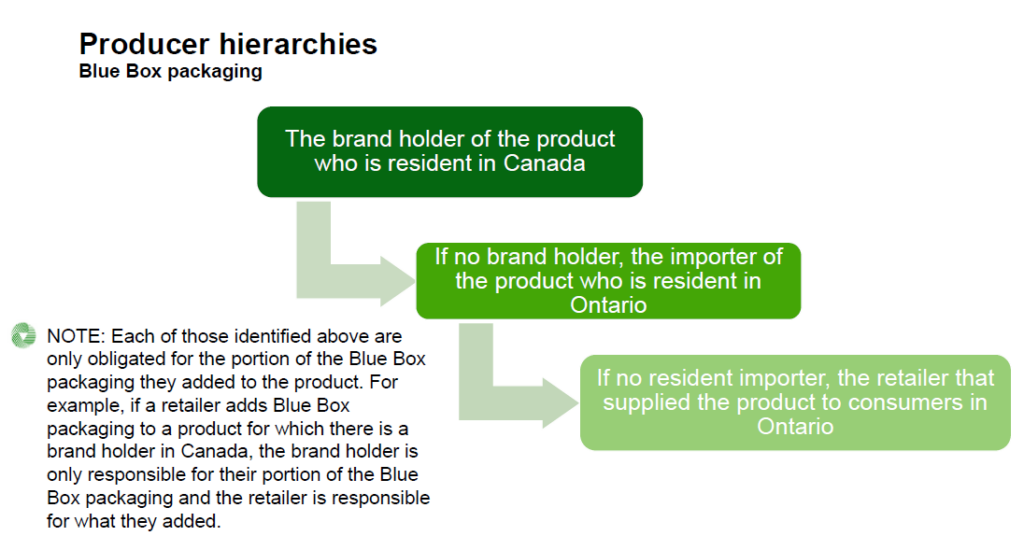
For the portion of the product packaging that a brand holder added to the product, a person is considered a producer:
- if they are the brand holder of the product and are resident in Canada
- if no resident brand holder, they are resident in Ontario and import the product from outside of Ontario
- if no resident importer, they are the retailer that supplied the product directly to consumers in Ontario
- if the retailer who would be the producer is a marketplace seller, the marketplace facilitator is the obligated producer
- if the producer is a business that is a franchise, the franchisor is the obligated producer, if that franchisor has franchisees that are resident in Ontario
For the portion of the product packaging that an importer of the product into Ontario added to the product, a person is considered a producer:
- if they are resident in Ontario and import the product from outside of Ontario
- if no resident importer, they are the retailer that supplied the product directly to consumers in Ontario
- if the retailer who would be the producer is a marketplace seller, the marketplace facilitator is the obligated producer
- if the producer is a business that is a franchise, the franchisor is the obligated producer, if that franchisor has franchisees that are resident in Ontario
For any portion of the packaging that is not described above, the producer is the retailer who supplied the product to consumers in Ontario.
-
Under the Blue Box Regulation, a packaging-like product is:
- ordinarily used for the containment, protection, handling, delivery, presentation or transportation of things
- ordinarily disposed of after a single use
- not used as packaging when it is supplied to the consumer
Packaging-like products include aluminum foil, a metal tray, plastic film, plastic wrap, wrapping paper, a paper bag, beverage cup, plastic bag, cardboard box or envelope, but does not include a product made from flexible plastic that is ordinarily used for the containment, protection, or handling of food, such as cling wrap, sandwich bags, or freezer bags.
If a producer is unsure whether or not their product is a packaging-like product, they can ask themselves the following questions to help determine whether the product is obligated to be reported under the Blue Box Regulation:
- Is the product actually packaging around a separate product?
- If yes, the product is not a packaging-like product. Instead, the product is considered blue box packaging and must be reported as blue box material. If no, continue to the next question.
- Is the product used for the containment, protection, handling, delivery, presentation or transportation of a thing(s)?
- If no, the product is not a packaging-like product. If yes, continue to the next question.
- Is the product typically disposed of after a single use (regardless if some may wash and reuse it)?
- If no, the product is not a packaging-like product. If yes, continue to the next question.
- Is the product made from flexible plastic that is for the containment, protection or handling of food?
- If yes, the product is not a packaging-like product. If no, the product is a packaging-like product and must be reported as blue box material.
If a producer is still unsure whether or not their product is a packaging-like product, they should contact the Compliance and Registry Team at 833-600-0530 or [email protected].
-
The regulation requires notices to be filed for three types of activities. For details on when notices may be required, please refer to the Ministry’s Handout on Excess Soil Registry:
1. Notice filings for excess soil from Project Areas that can be made by a Project Leader or Authorized Person and may require retaining a Qualified Person. These notices will be required to be filed before soil that will become excess soil is removed from the Project Area. There will be two fillings for each notice:
1. An initial filing before the soil is removed, which will require the following information to be provided:
-
- a description of the project and Project Area including the location of each property within the project area
- the contact information of the Project Leader, Operator or Authorized Person and the person responsible for transportation, and if applicable, the qualified person
- an estimated amount of the soil that will be generated broken down by quality standard
- a list of substances/materials that were added to the soil
- the location of temporary or final sites that the soil will be transported to
- details of the Reuse Site(s) where the soil will be moved to
- information on any peer review or certification processes if applicable
- and a declaration by the Project Leader.
- A final notice within 30 days after excess soil has been removed from the Project Area or temporary site which will require the following information:
- the amount of excess soil removed from the Project Area that was deposited at: a class 1 soil management site, a class 2 soil management site, a reuse site, a local waste transfer facility, and a landfilling site or dump
- the date on which the last load of excess soil was removed from the project area or temporary site
- a declaration by the Project Leader confirming that all requirements were followed related to the filing of the notice
The Project Leader or Authorized Person is required to ensure the notice filings that are no longer complete or accurate are updated within 30 days after the day the person becomes aware that the information is no longer complete or accurate.
Exemptions
Exemptions from filing a notice in the Excess Soil Registry can be found under Schedule 2 of the regulation.
The Project Leader, Operator or Authorized Person may file a notice after soil that will become excess soil has been removed from the project area if:
- conducting the required sampling and analysis at the project area is impractical
- the soil is removed from the project area and delivered to a temporary site to conduct the required sampling, and
- the Project Leader, Operator or Authorized Person makes sure the required sampling is conducted as soon as the soil is delivered to the temporary site
If soil is removed before a notice is filed in the Registry, the Project Leader, Operator, or Authorized Person is required to ensure that the notice is filed in the Registry before the soil that has become excess soil is transported from the temporary site to the final site.
- Notice filings for Residential Development Soil Depots can be made by an Owner, Operator, or Authorized Person. This notice will be required before excess soil is deposited on a residential development soil depot site.
The Owner or Operator of the Residential Development Soil Depot must ensure that the quality of the excess soil accepted and managed at the depot meets the applicable Excess Soil Quality Standards set out in the regulation. There will be two filings for each notice:
- An initial filing before the soil is received, which will require the following information to be provided:
- the site location
- the contact information of the Site Owner and Operator
- the project commencement date
- the estimated amount of soil (including inventory on-site)
- the site instrument identification
- and a declaration by the Site Owner or Operator.
- A final filling within 90 days of the depot closing indicating the date when the depot ceased operations, and a declaration by the Site Owner or Operator.
- Notice filings for Reuse Sites can be made by a Site Owner, Operator, or an Authorized Person. These apply to a Reuse Site that expects at least 10,000 m3 of excess soil to be deposited for an undertaking. There will be two filings for each notice:
- An initial filing before the excess soil is deposited, which will require the following information to be provided:
- the site location/property type
- the contact information of the Site Owner and Operator
- a description of the undertaking
- the applicable excess soil quality standards for the site
- the estimated amount of soil by quality standard
- the estimated dates when the first and last soil load will be deposited
- the site instrument identification
- and a declaration by the Site Owner or Operator.
- A final notice filing within 30 days after the final load of excess soil has been deposited at the Reuse Site which will require the following information:
- confirmation that all excess soil that will be reused for a beneficial purpose has been deposited at the reuse site
- the total amount of excess soil that was deposited
- the date the final load of excess soil was deposited
- and a declaration by the owner or operator.
The Site Owner or Operator is required to update notice filings that are no longer complete or accurate within 30 days after the day the person becomes aware that the information is no longer complete or accurate.
Exemption:
Reuse Sites that are part of an infrastructure undertaking are not required to file notices, even if they generate more than 10,000 m3 of excess soil.
-
-
Under the Blue Box Regulation, there are three types of exemptions that apply to producers:
- Based on a producer’s gross annual revenue,
- based on the weight of Blue Box materials supplied into Ontario, and
- for producers of newspaper
1. Any producer whose gross annual Ontario revenue from products and services is less than $2,000,000 is exempt from all producer requirements under the regulation. In the case where the producer is a franchisor, it is the gross annual revenue of the system that is used to determine if an exemption applies.
Any producer who meets the exemption must keep any records that demonstrate its gross annual Ontario revenue is less than $2,000,000 in a paper or electronic format that can be examined or accessed in Ontario for a period of five years from the date of creation.
See our FAQs to understand what revenues municipalities and registered charities should consider when determining whether or not they are an exempt producer.
2. A producer who is above the revenue-based exemption level may still be exempt from performance requirements (collection, management and promotion and education) if their supply weight is below the exemption levels outlined in the table below.
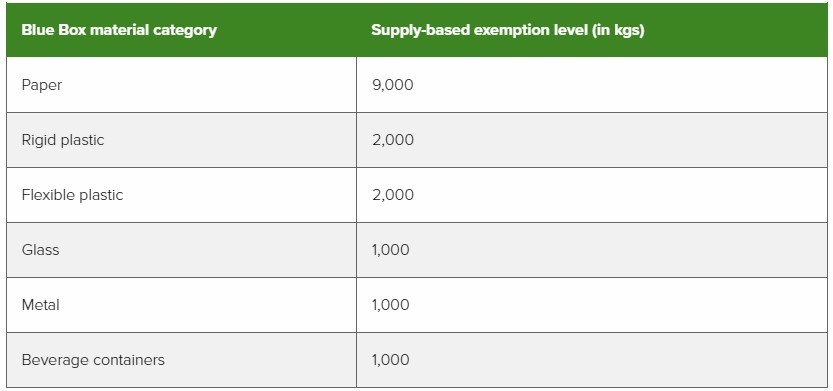
If a producer’s annual revenue is more than $2,000,000 and supply weight in all material categories is less than the tonnage exemption threshold, the producer is required to register and report.
If a producer’s annual revenue is more than $2,000,000 and supply weight in at least one material category is above the tonnage exemption threshold, the producer is required to meet all obligations (registration, reporting, collection, management, and promotion and education). However, producers are only required to meet their minimum management requirement in material categories where they are above the exemption level.
3. As outlined in the amended Blue Box Regulation (released April 19, 2022), producers of newspapers may be exempt from collection, management, and promotion and education requirements. For the purposes of this exemption, “newspapers” includes newspapers and any protective wrapping and any supplemental advertisements and inserts that are provided along with the newspapers.
For a producer to qualify for this exemption, newspapers must account for more than 70% of their total weight of Blue Box materials supplied to consumers in Ontario in a calendar year. If exempt, the producer is not required to meet collection, management, and promotion and education requirements for all Blue Box materials they supply in Ontario in the following two calendar years.
A producer whose newspaper supply accounts for 70% or less of their total weight of Blue Box materials is subject to collection, management, and promotion and education requirements for all Blue Box materials they supply in Ontario.
-
A producer’s management requirement is how much Blue Box material they must ensure is collected and processed into recovered resources each year. Management requirements are calculated based on what they supplied into Ontario one year prior and the resource recovery percentage as set in the regulation. A producer’s management requirement is calculated separately for each Blue Box material category (beverage container, glass, flexible plastic, rigid plastic, metal and paper).
Some producers are exempt from having a management requirement based on their supply data, for more information on exemptions see the FAQ Are there exemptions for Blue Box producers? If a producer does not have a management requirement they do not have any collection, management or promotion and education obligations.
A producer with a management requirement must also provide collection and promotion and education services in Ontario. Most producers will contract the services of a producer responsibility organization (PRO) to meet their collection, management and promotion and education obligations.
To view your management requirement(s), log into your registry account, download a copy of your Blue Box Supply Report and review the section with your minimum management requirements. Management requirements for a given year are determined by supply data from two years prior. For example, 2026 management requirements were based on 2024 supply data (submitted in producers’ 2025 Supply Report).
Unsure if you are a Blue Box producer? See our FAQs Am I a producer of Blue Box product packaging? And Am I a producer of paper products and packaging-like products?
-
See our FAQs to understand “What are paper products?” and “What are packaging-like products?”.
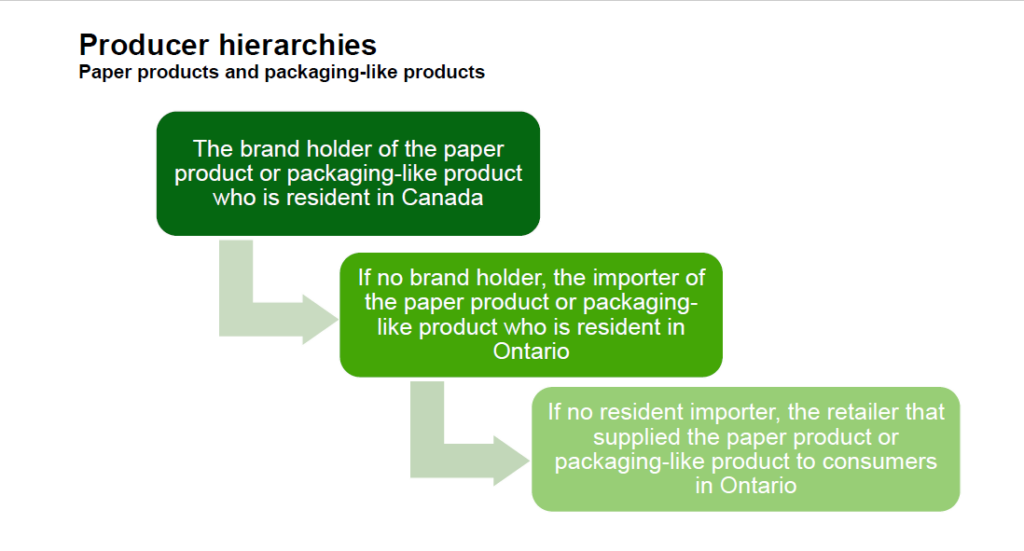
For paper products and packaging-like products, a person is considered a producer:
- if they are the brand holder of the paper product or packaging-like product and are resident in Canada
- if no resident brand holder, they are resident in Ontario and import the paper product or packaging-like product from outside of Ontario
- if no resident importer, they are the retailer that supplied the paper product or packaging-like product directly to consumers in Ontario
- if the retailer who would be the producer is a marketplace seller, the marketplace facilitator is the obligated producer
- if the producer is a business that is a franchise, the franchisor is the obligated producer, if that franchisor has franchisees that are resident in Ontario
-
There are exemptions under the HSP Regulation for category A and B producers. If an HSP producer meets the exemption threshold for a material type, they are not required to establish a collection system, manage those materials or implement a promotion and education program.
Producers of refillable pressurized containers that meet the exemption threshold are still required to provide a call-in collection service.
An HSP producer qualifies for an exemption if their average weight of supply for the previous calendar year is less than or equal to the weight (in tonnes) specified in the chart below:
Type of HSP Exempt (Less than <) Oil Filters 3.5 Non-refillable Pressurized Containers 3 Antifreeze 20 Oil Containers 2 Solvents 3 Paints and Coatings 10 Pesticides 1 Refillable Pressurized Containers 8 Mercury-containing Devices N/A Fertilizers Propane Containers (refillable) Producers must verify that they continue to meet the exemption annually, since their average weight of supply will change from year to year.
See our FAQ “Am I a small, large, or exempt HSP producer?” to determine how to calculate if you are an exempt HSP producer.
HSP producers that meet the exemption criteria are exempt from:
- Registering and reporting to RPRA
- Establishing a collection and management system
- Meeting a management requirement
- Promotion and education requirements
Exempt producers must keep records related to the weight of HSP supplied into Ontario each year and provide them to RPRA upon request.
Producers are advised to confirm their exemption with the Compliance and Registry Team at 1-833-600-0530 or [email protected].
-
Producers are not required to collect and manage their own branded products and materials. Instead, a producer is expected to collect and manage a portion of similar materials in Ontario. The portion of material that a producer collects and manages is known as their minimum management requirement. A minimum management requirement, which is set based on calculations outlined in the applicable Regulation, is the weight of the products or packaging that the producer must ensure is collected and managed. The calculated amount is proportionate to the weight of materials that producer supplied into the province.
For example, a producer who supplied laptops into Ontario does not need to collect and manage their own branded laptops. Instead, they must ensure that they collect and manage an equivalent weight of information technology, telecommunications, and audio-visual equipment (ITT/AV) materials.
Similarly, a producer who supplied cardboard boxes into Ontario does not need to collect and manage those exact cardboard boxes. Rather, they need to ensure that an equivalent weight of paper is collected and managed.
Almost all producers will work with producer responsibility organizations (PROs) for the purposes of meeting their obligations to collect and manage materials. PROs establish collection and management systems across Ontario for different material types. A producer can meet their obligations to collect and manage materials by entering into a contract with a PRO to provide these services on their behalf.
-
As required under the regulation, Project Leaders, Owners and Site Operators are required in prescribed circumstances to use the Excess Soil Registry to file notices for certain Project Areas, Reuse Sites, and Residential Development Soil Depot sites where Excess Soil is generated, transported, temporarily placed, and deposited. More information on the types of projects and sites required to file a notice can be found by referring to the Ministry’s Handout on Excess Soil Registry.
Project Leaders, Owners and Site Operators can also assign an Authorized Person to file a notice and pay fees in the Registry on their behalf.
Role definitions
Project Leader
In O. Reg. 406/19, the Project Leader means, in respect of a project, the person or persons who are ultimately responsible for making decisions relating to the planning and implementation of the project.
The Project Leader is responsible for ensuring that a Project Area Notice is filed if required. They must always complete and sign the required declarations that are a component of the notice being filed .
Owner
A person who owns the land, with an interest upon whose credit, behalf, privity or direct benefit an improvement is made to the premises.
For a Reuse Site or a Residential Development Soil Depot, an Operator may complete all aspects of the relevant notice filing in the Registry.
Operator
A person who has the charge, management, or control of a site. An Operator may be an owner of a property, lease a property or be contracted to operate a Project Area Site, Reuse Site or Residential Development Soil Depot.
For a Reuse Site or a Residential Development Soil Depot, an Operator may complete all aspects of the relevant notice filing in the Registry.
Authorized Person
A person who is authorized by the Project Leader, Owner, or Operator of a site, to complete a notice filing and pay fees on their behalf.
The Authorized Person can initiate a notice in the Registry if permitted to by the Project Leader, Owner, or Operator of a site, and can complete all required notice information and pay applicable fees on their behalf.
Qualified person (QP)
QPs under the regulation have the same meaning as section 5 and 6 of Ontario Regulation 153/04 (O. Reg. 153/04).
Section 5 of O. Reg. 153/04 defines a Qualified Person as professional engineers and geoscientists – these are the persons who may oversee or conduct environmental site assessments or complete certifications in a Record of Site Condition. Section 6 of O. Reg. 153/04 sets out the requirements for Qualified Persons who conduct or oversee a risk assessment.
A QP may be designated as an Authorized Person by the Project Leader or by an Owner/Operator to file a notice to the Excess Soil Registry on their behalf.
-
Impacts on producers of antifreeze and/or oil filters provided in new vehicles
Supply reporting
Vehicle brand holders, importers and marketers are now obligated for antifreeze and/or oil filters that are supplied in new vehicles sold in Ontario.
Subsection 7(2) of the amended HSP Regulation states that these producers must report to RPRA the weights of antifreeze and/or oil filters that were supplied in new vehicles sold in Ontario in 2022, 2023 and 2024. This change to the producer hierarchy may impact supply reports previously submitted to RPRA. It may also require producers to submit a supply data verification report if they meet the definition of a large producer, based on the newly submitted supply data. Producers who need to submit adjusted supply data as a result of this change to the producer hierarchy should contact RPRA before July 31, 2025.
Although there may be adjustments to the historical supply data, the collection and management requirements for the 2025 calendar year remain unchanged.
Management requirements
Beginning January 1, 2026, these vehicle brand holders, importers and marketers of antifreeze and/or oil filters supplied in new vehicles will also be required to fulfill collection and management obligations, including reporting on their performance in meeting their obligations.
This includes ensuring there are sufficient collection sites in a community based on the size of the producer and that the HSP material is managed within 3 months of being collected. Specifically, oil filter producers must ensure that the weight of the recovered resources from managing oil filters in 2026, and every year thereafter, meets or exceeds their individual management requirement as calculated under subsection 31(3) of the HSP Regulation.
Impacts on producers of antifreeze and/or oil filters not supplied in new vehicles
The producer hierarchy for antifreeze and/or oil filters supplied in containers (i.e., not supplied in new vehicles) remains unchanged.
These producers may have reported tonnage for antifreeze and/or oil filters supplied in new vehicles as part of their supply reports in previous years and, if so, they should contact RPRA before July 31, 2025 to clarify their obligations and make changes to their supply data, as required.
-
You are a hazardous and special products (HSP) producer if you market antifreeze and oil filters (excluding those provided in new vehicles, for which a separate hierarchy applies as outlined below), oil containers, solvents, paints and coatings, pesticides, fertilizers, pressurized containers or refillable propane containers to consumers in Ontario and:
- You are the brand holder and have residency in Canada;
- If there is no resident brand holder, you have residency in Ontario and import from outside of Ontario;
- If there is no resident importer, you have residency in Ontario and market directly to consumers in Ontario (e.g., online sales); or
- If there is no resident marketer, you do not have residency in Ontario and market directly to consumers in Ontario (e.g., online sales).
You are a hazardous and special products (HSP) producer if you market oil filters and antifreeze provided in new vehicles into Ontario and:
- You are the manufacturer of the new vehicle and have residency in Canada;
- If there is no resident vehicle manufacturer, you have residency in Ontario and import the vehicle from outside of Ontario;
- If there is no resident importer, you have residency in Ontario and market the vehicle directly to consumers in Ontario; or
- If there is no resident marketer, you do not have residency in Ontario and market the vehicle directly to consumers in Ontario.
You are a hazardous and special products (HSP) producer if you market mercury-containing barometers, thermometers or thermostats into Ontario and:
- You are the brand holder and have residency in Canada; or
- You are the brand holder of barometers, thermometers or thermostats marketed to consumers in Ontario that do not contain mercury
You are a hazardous and special products (HSP) producer if you market fertilizers into Ontario and:
- You are the brand holder and have residency in Canada
Even if you do not meet the above definitions, there may be circumstances where you qualify as a producer. Read the Hazardous and Special Products Regulation for more details or contact the Compliance Team for guidance at [email protected] or toll-free at 1- (833) 600-0530.
Related FAQs:
-
Beginning October 1, 2021, producers of oil filters and non-refillable pressurized containers, or PROs acting on their behalf, are required to establish and operate a promotion and education program including the following:
- promote their collection and management services with respect to the type of HSP they are obligated for
- provide the following information on a website with respect to that type of HSP:
- the location of each HSP collection site established or operated by the producer that is accessible to the public and the types of HSP accepted at each site
- the location and date of each HSP collection event held by the producer and the types of HSP accepted at each event
- a description of the collection services provided by the producer, other than HSP collection sites and HSP collection events
- a description of how the producer manages that type of HSP after it is collected
- create promotional and educational materials with respect to that type of HSP that include the following:
- the website URL
- a description of how that type of HSP is collected and managed
- the producer shall make the promotional and educational materials available to retailers that supply that type of HSP, municipal governments and Indigenous communities, and shall solicit and consider feedback on how the promotional and educational materials can be improved
- the producer shall promote each HSP collection event for that type of HSP in the local municipality or territorial district where it will be held for at least one week prior to the date of the event using a combination of two or more forms of media, including but not limited to:
- local print publications
- local print media
- local radio
- local signage or social media
-
Beginning October 1, 2021, producers, or PROs acting on their behalf, of oil containers, antifreeze, pesticides, solvents, paints and coatings are required to establish and operate a promotion and education program including the following:
- Promote their collection and management services with respect to the type of HSP they are obligated for
- Provide the following information on a website with respect to that type of HSP:
- the location of each HSP collection site established or operated by the producer that is accessible to the public and the types of HSP accepted at each site
- the location and date of each HSP collection event held by the producer and the types of HSP accepted at each event
- a description of the collection services provided by the producer, other than HSP collection sites and HSP collection events
- a description of how the producer manages that type of HSP after it is collected
- Create promotional and educational materials with respect to that type of HSP that include the following:
- the address of the website
- a description of how that type of HSP is collected and managed
- The producer shall make the promotional and educational materials available to retailers that supply that type of HSP, municipal governments and Indigenous communities, and shall solicit and consider feedback on how the promotional and educational materials can be improved
- The producer shall promote each HSP collection event for that type of HSP in the local municipality or territorial district where it will be held for at least one week prior to the date of the event using a combination of two or more forms of media, including but not limited to:
- local print publications
- local print media
- local radio
- local signage or social media
-
Operators of tire collection sites will have to independently enter into commercial agreements with producers or producer responsibility organizations (PROs) to secure tire collection services. As long as a collection site is part of a producer’s tire collection system, the producer, or their PRO, is obligated to ensure tires are picked up from that site.
Since producers have legal obligations under the Tires Regulation, producers, or their PROs, will need tires to meet their management requirements. While tire collectors (i.e., operator of collection sits) are no longer required to register with RPRA, the collection site must be part of a producer’s collection system for the tires to count toward a producer’s management requirements
A list of registered PROs and producers is available on RPRA’s website on the Find a registrant page.
-
No. The list of products obligated under the EEE Regulation is different from the list of products included in the OES Program. The OES Program required producers to report the number of units they supplied, while the EEE Regulation requires producers to report the total weight of products.
To help producers calculate the weight of their products, we have included weight conversion factors in our Verification and Audit procedure, which is included as a weight conversion tool on the registration form. Once a producer determines the units of products on which they are obligated to report, they can enter the units into the conversion tool to get a calculated weight to report to RPRA.
For more information, see the Determining Supply Data section of the Registry Procedure: EEE Verification and Audit.
-
Starting in 2026, electronics (i.e. information technology, telecommunications and audio-visual (ITT/AV) equipment) producers will have a fee holiday and will not be required to pay program fees. Producers are still required to submit their annual supply report by the deadline, but the associated fees will not apply.
The fee holiday is funded through the $17.5 million in residual funds transferred to RPRA from the legacy recycling program for electronics. You can learn more about the transfer of funds here.
The fee holiday will continue until the funds are depleted. RPRA will provide updates to producers ahead of program fees for electronics coming back into effect.
Program fees still apply for all other programs, so producers in multiple programs are required to pay fees when submitting supply reports for other programs.
-
Each Registry account has one account admin, who is responsible for enrolling the company in programs (e.g., HWP, batteries, etc.) and adding/removing additional account users.
There is one primary user for each program enrolment. In HWP, the primary user can add/remove users to the HWP program, add program roles (such as generator, carrier or receiver) and receive email notifications (such as when a new invoice is available).
Secondary users can create and edit generator facilities and waste information (generator/AGD roles only), add ECA information and edit contact information (carrier/receiver roles only), and create, edit and sign manifests.
Driver users are specific to the carrier role in HWP. Drivers can create, edit and sign manifests but cannot add ECA information.
Manifest-only users, like driver users, have a reduced level of access limited to viewing, creating, editing and signing manifests. They cannot view, edit, or manage facilities, or view information related to fees.
There is one accounts payable (AP) user per account. An AP user can access and pay invoices, manage saved payment methods and receive email notifications about billing and payments. The AP user can also be contacted by RPRA in the event of a billing or payment question. If the AP user has a primary access level in the HWP registry, they also can reset passwords for active users and add or remove users within the same program. If an AP user has a secondary access level in the HWP, they can create and manage facilities and waste, as well as view, create, or edit manifests.
Account admins can manage password resets for all active users in the account. Primary users are also able to manage password resets, but only for active users within the programs they are the primary user for. If secondary users, drivers or manifest-only users require a password reset, they can reach out to the account admin or primary user to do so.
User Management
Functionalities Admin Primary Secondary AP User Driver* Manifest-only Add/remove users across programs ⚫ Reset passwords for all users across programs ⚫ Add / remove users to same program ⚫ ⚫ ⚫(only if given primary access to the program) Reset passwords for active users within the same program ⚫ ⚫ ⚫(only if given primary access to the program) Receive invoice notifications ⚫ ⚫ ⚫ Create / manage facilities ⚫ ⚫ ⚫ ⚫ Create / manage wastes ⚫ ⚫ ⚫ ⚫ View / create / edit and sign manifests ⚫ ⚫ ⚫ ⚫ ⚫ ⚫ *Available only to accounts where the carrier role is selected. Drivers will only be able to view and action manifests where the company is listed as the carrier -
No. RPRA does not administer contracts or provide incentives. Under the Regulations, producers will either work with a producer responsibility organization (PRO) or work directly with collection sites, haulers, refurbisher’s and/or processors to meet their collection and management requirements. Any reimbursement for services provided towards meeting a producers’ collection and management requirements will be determined through commercial contracts.
To discuss any payment, contact your service provider or a PRO. RPRA does not set the terms of the contractual arrangements between PROs and producers.
-
You are a tire producer if you supply new tires to consumers in Ontario and you have a permanent establishment in Canada. New tires are supplied to Ontario in two ways – sold on new vehicles or sold as loose tires. The definition for tires producers (as outlined in section 3 of the Tires Regulation) applies in both cases.
New loose tires that are marketed to consumers in Ontario
- For new tires where there is a brand holder resident in Canada: you are the producer for those new tires if you are the brand holder of the new tires (the legislation defines brand holder to mean a person who owns or licenses a brand or who otherwise has rights to market a product under the brand) and resident in Canada.
- For new tires where there is no brand holder resident in Canada: you are the producer for the new tires if you are the importer of those new tires and resident in Ontario.
- For new tires where there is no brand holder or importer resident in Ontario: you are the producer for the new tires if you are the first person to market those tires in Ontario and resident in Ontario.
- For new tires where there is no brand holder, importer or marketer resident in Ontario: you are the producer for the new tires if you are the person that marketed those new tires and non-resident in Ontario.
New vehicles with new tires that are marketed to consumers in Ontario
- For new vehicles where there is a brand holder resident in Canada: you are the producer for the new tires on those new vehicles if you are the manufacturer of the vehicles (the legislation defines vehicle to include motor vehicles, muscular-powered equipment and trailers) and resident in Canada.
- For new vehicles where there is no manufacturer resident in Canada: you are the producer for the new tires on those new vehicles if you are the importer of those new vehicles and resident in Ontario.
- For new vehicles where there is no manufacturer or importer resident in Ontario: you are the producer for the new tires on those new vehicles if you are the marketer of those new vehicles in Ontario and resident in Ontario.
- For new vehicles where there is no manufacturer, importer or marketer resident in Ontario: you are the producer for the new tires on those new vehicles if you are the marketer of those new vehicles and non-resident in Ontario.
-
When to register as a producer
Producers of oil filters and non-refillable pressurized containers, oil containers, antifreeze, pesticides, refillable pressurized containers, solvents, paints and coatings
If the producer’s average weight of supply in 2018, 2019, 2020 was above the threshold in the table below, the producer was required to register with RPRA by November 30, 2021. Obligated producers who have not yet registered are out of compliance with the regulation and may face compliance action by RPRA.
If a producer was not required to register in 2021, they must register on or before July 31 of the first calendar year that they exceed the threshold in the table below.
Type of HSP Average weight of supply from the previous three calendar years (tonnes) Oil Filters 3.5 Non-refillable pressurized containers 3 Antifreeze 20 Oil Containers 2 Paints and coatings 10 Pesticides 1 Refillable pressurized containers 8 Solvents 3 For assistance in calculating your average weight of supply, contact RPRA’s Compliance Team at [email protected].
Producers of mercury-containing barometers, thermometers and thermostats, fertilizers and refillable propane containers
If a producer met the definition of an HSP producer in 2021, they were required to register with RPRA by November 31, 2021.
If you meet the definition of an HSP producer after November 31, 2021, you must register with RPRA within 30 days.
How to register as a producer
- Go to RPRA’s Registry at https://registry.rpra.ca/s/login/?language=en_US
- Note: The Registry will not work with the Internet Explorer web browser. Google Chrome is the recommended web browser to use.
- Click “Don’t have an Account? Create a new Account”.
- Follow the prompts to fill out your account details.
- Information needed at time of registration:
- CRA business number, business name, address, contact information, and
- Name, contact information of the person who will be responsible for completing registration.
- Information needed at time of registration:
- You’ll receive an email with a link to create your password.
- Select the program you want to enroll in.
- Submit a supply report with the total weight of each type of HSP that was supplied to consumers in Ontario in the previous years.
For more information and step by step instructions on how to submit a supply report, view our supply reporting guides here.
- Go to RPRA’s Registry at https://registry.rpra.ca/s/login/?language=en_US
-
No, producers are not required to sign up with a PRO to meet their regulatory requirements. It is a business decision if a producer chooses to work with a PRO, and a producer can choose to meet their obligations without a PRO.
Most producers will choose to contract with a PRO to provide collection, hauling, processing, retreading and/or refurbishing services to achieve their collection and management requirements unless they carry out these activities themselves.
-
Beginning October 1, 2021, producers or PROs acting on their behalf, of mercury-containing devices are required to establish and operate a promotion and education program that:
- Promotes their collection and management services with respect to the type of HSP they are obligated for
- Provides the following information on a website with respect to that type of HSP:
- the presence of mercury in that type of HSP
- how to distinguish that type of HSP from similar products that do not contain mercury
- the hazards to human health and the environment related to mercury
- how consumers can properly dispose of that type of HSP
- a description of the collection services provided by the producer under this Regulation for that type of HSP
- a description of how the producer manages that type of HSP after it is collected under this Regulation
- Creates promotional and educational materials with respect to that type of HSP that include the following:
- the address of the website
- a description of how that type of HSP is collected and managed
- The producer shall make the promotional and educational materials available to retailers that supply that type of HSP or similar products that do not contain mercury, municipal governments, and Indigenous communities, and shall solicit and consider feedback from those retailers, municipal governments and Indigenous communities on how the promotional and educational materials can be improved
-
Yes, a producer, a PRO (producer responsibility organization) on behalf of a producer, or a service provider on behalf of either party, can collect any product or material (including materials or products that are not designated under the Resource Recovery and Circular Economy Act, 2016 (RRCEA)). For example, a battery producer may choose to collect batteries that weigh over 5kg; a tire producer may choose to collect bicycle tires; or a Blue Box producer may choose to collect books.
Products or materials that are not designated under RRCEA regulations cannot be counted towards meeting a producer’s collection or management requirements under RRCEA.
If designated materials are co-collected with materials that are not designated, a person must use a methodology or process acceptable to the Authority to account for those materials. Anyone considering this can contact the Compliance Team to discuss at [email protected] or 833-600-0530.
For example, if bicycle tires are collected at the same time as automotive tires, they must be accounted for separately both when collected and when sent to a processor.
-
Producers, or PROs acting on their behalf, are required to establish and operate a system for managing HSP by satisfying their management requirements as follows:
- All oil containers, antifreeze, solvents, paints and coatings picked up from a collection site must be processed within three months from the date of the pickup
- Producers must ensure that materials are processed by an HSP processor registered with RPRA. In 2027, producers or PROs on their behalf must use a processor who met, at a minimum, the average recycling efficiency rate (RER) specified in the table below in the calendar year two years prior for the type of HSP:
Type of HSP Average Recycling Efficiency Rate (RER) percentage Antifreeze 90 Oil Containers 95 Paints and Coatings 75 Solvents 10 - Producers of pesticides must ensure that pesticides are properly disposed of at an HSP disposal facility registered with RPRA no later than three months after the day the pesticides are collected.
-
Individual Producer Responsibility (IPR) means that producers are responsible and accountable for collecting and managing their products and packaging after consumers have finished using them.
For programs under the Resource Recovery and Circular Economy Act, 2016 (RRCEA), producers are directly responsible and accountable for meeting mandatory collection and recycling requirements for end of life products. With IPR, producers have choice in how they meet their requirements. They can collect and recycle the products themselves, or contract with producer responsibility organizations (PROs) to help them meet their requirements.
-
RPRA’s Audit and Risk Team uses a three-stage risk-based framework to verify reporting accuracy, address data gaps, and enforce regulatory compliance.
Whether or not a producer is required to go through all three stages will depend on the outcomes at each stage. Findings from the initial risk assessment will determine whether producers undergo a verification review; the results of the verification review will determine whether producers are subject to an audit.
Details about each stage are outlined below:
- Risk assessment
- Selected producers will be asked to complete and submit a Blue Box Supply Assessment Form by a set deadline. Failure to complete the form by the deadline will trigger escalating compliance enforcement actions.
- If no further risks or data gaps are identified, additional outreach may not be required.
- Verification review
- RPRA will commence a formal verification review if a producer’s data requires deeper verification.
- An assigned Audit and Risk Officer (ARO) will manage the case and work directly with the producer.
- Producers must supply AROs with all requested documentation, methodology details, and records necessary to validate reported supply data.
- Audit
- Verification inspections that uncover multiple high-risk issues or unresolved inconsistencies will be escalated to a formal audit.
- Producers will receive a formal audit notification letter alongside a list of required records.
- Audits will include on-site visits by AROs to outline the scope of the audit work, review internal procedures, test source records, and evaluate end-to-end reporting controls.
- Following the audit, RPRA will issue recommendations and conduct follow-up reviews to verify that requested corrective actions to internal processes and reporting adjustments have been completed.
- Producers are reminded that failure to submit the required information at any stage in the inspection process may lead to enforcement action.
For more information, see our FAQ: Why was I was selected for a verification inspection of my 2026 to be part of the Blue Box Inspection Campaign supply data?
- Risk assessment
-
RPRA’s Compliance and Enforcement Team is undertaking a risk-based review of 2026 Blue Box supply data submitted by producers. The following risk factors were considered when selecting producers for inspection:
- Producers filing deductions: Supply report submissions containing material deductions, where larger deduction volumes or multiple submissions increase regulatory risk.
- Producers claiming compostable exemptions: Supply report submissions claiming exemptions for compostable materials, particularly those involving large volumes or multiple filings.
- Significant year-over-year variance: Producers displaying substantial unexplained changes in reported supply tonnage compared to previous years.
- High-volume producers: Market participants representing significant overall quantities of system tonnage.
- Inconsistent registration history: Producers who have not registered consistently every reporting year.
This inspection process prioritizes data validation and evaluation of historical submissions. The process is meant to enhance reporting accuracy and, where required, enforce regulatory requirements to help ensure that all Blue Box producers are held to a consistently high standard of compliance.
For more information, see our FAQ: What is the process for the 2026 Blue Box supply data inspection campaign?
-
Unbranded products are products that do not have any mark, word, name, symbol, design, device or graphical element, or any combination of these, including a registered or unregistered trademark, which identifies a product and distinguishes it from other products.
The retailer who supplied the product to a consumer in Ontario, either online or at a physical location, is the obligated producer for the supply of Blue Box packaging on that unbranded product.
For example: A cucumber in plastic film sold at a grocery store that does not have any stickers, labeling or any other information associated with a brand is considered unbranded. As the retailer for that unbranded product, the grocery store is the obligated producer for the packaging supplied with the cucumber.
-
As of January 1, 2026, the Blue Box Program has fully transitioned to producers of packaging, paper products and packaging-like products and municipalities are no longer responsible for operating or funding the residential Blue Box Program.
The transition of the Blue Box Program is part of the Ontario government’s circular economy initiative under which producers are required to be financially responsible and accountable for their products and packaging when consumers are finished using them.
Circular Materials is the organization responsible for operating the Blue Box collection system on behalf of producers.
For questions specific to your Blue Box collection service, please visit their website and type in your community’s name.
-
Free riders are obligated parties that:
- Have not registered or reported to RPRA
- Have not established a collection and management system (if they are so required to), or;
- Are not operating a collection and management system (if they are so required to).
See our FAQs to understand “What is RPRA’s approach to free riders?”, and “What do I do if I think a business is a free rider?”
To note:
- Some producers only have requirements to register and report. Please refer to your specific program page on our website to understand producer obligations.
- Collection and management systems may be accomplished by a producer responsibility organization (PRO) on behalf of a producer through contractual arrangements between the producer and PRO. If a PRO is managing a producer’s collection and management requirements, producers must identify that PRO to RPRA.
-
For the 2024 performance report, all HSP processors are not required to report on their RER.
Amendments to the Hazardous and Special Products (HSP) Regulation have changed the RER requirements for the 2025 calendar year and going forward, depending on the material category:
- Category A (oil filters and non-refillable pressurized containers):
Effective in 2025, and going forward, processors of Category A materials are no longer required to calculate or report on their RER. Producers (or PROs on their behalf) are no longer required to work with processors that meet specified RERs.
- Category B (antifreeze, oil containers, paints and coatings and solvents, but not pesticides) and Category C (barometers, thermometers and thermostats):
In 2027, producers (or PROs on their behalf) must use a processor who met, at a minimum, the average RER specified in the table below in the calendar year two years prior for the type of HSP.
Type of HSP Average RER percentage Antifreeze 90 Barometers, thermometers, thermostats 90 Oil containers 95 Paints and coatings 75 Solvents 10 - Category D (fertilizers), Category E (refillable propane containers and refillable pressurized containers), and pesticides (Category B):
These materials do not have any RER requirements.
-
Here are the lists of registered PROs:
Hazardous and Special Products PROs
These lists will continue to be updated as new PROs register with RPRA.
-
For the purposes of supply data reporting, ‘refillable packaging’ is defined as packaging surrounding a supplied product that a consumer can return to the product manufacturer for cleaning and reuse.
A producer who supplies its products in refillable packaging should only report weights (under the appropriate material category) the first time the packaging is supplied to consumers.
For example:
A milk producer that used 1000 new glass bottles to supply its product to consumers in 2022, reported the weight of all 1000 bottles under the beverage container category in their 2023 supply data report.
In 2023, the producer added 500 new glass bottles to its supply, bringing the total of supplied material to 1500 bottles. Their 2024 supply data report should only reflect the weights of the 500 new bottles, not the total currently being used by the producer (1500).
Important: Products supplied in beverage containers should be reported in the ‘beverage container’ category, not the category the container is made of (plastic, metal, glass).
See Compliance Bulletin: What blue box materials need to be reported?
-
The HSP Regulation has 13 materials obligated under it. Materials that share the same obligations have been grouped into categories.
Category A:
- Oil Filters: a fluid filter, other than a gasoline filter, and includes,
a) a spin-on style filter or element-style fluid filter that is sold separately or as part of a product, that is used in hydraulic, transmission or internal combustion engine applications,
(b) a filter used for oil, diesel fuel, storage tank fuel, coolant, household furnace fuel, and
(c) a sump type automatic transmission filter - Non-refillable pressurized containers: pressurized containers that are used for the supply of a gas product, including propane, but cannot be refilled
Category B:
- Antifreeze: a product that contains ethylene or propylene glycol used or intended for use as a vehicle engine coolant
- Oil containers: containers that have a capacity of 30 litres or less and that are used for the supply of new lubricating oil
- Solvents: products that are liquid intended to be used to dissolve or thin a compatible substance, aresupplied in a container that has a capacity of 30 litres or 30 kg or less, and that meet one or both of the following criteria:
- It is comprised of 10% or more of water-immiscible liquid hydrocarbons, including halogen-substituted liquid hydrocarbons
- It is flammable and is as described in Clause 4.2 and as defined in Clause 7.2 of CSA Standard Z752-03, “Definition of Household Hazardous Waste”
- Paints and coatings: latex, oil or solvent-based architectural coatings and includes paints and stains whether tinted or untinted, non-pesticide marine paints, paints for automotive craft and industrial applications
- Pesticides: pesticides, fungicides, herbicides or insecticides that are registered under the Pest Control Products Act (Canada)
Category C:
- Barometers: barometers, intended for residential use, that contain mercury and may contain electronic components
- Thermometers: thermometers that are intended for residential use to measure body or air temperature, that contain mercury and may contain electronic components
- Thermostats: thermostats that contain mercury, and may contain electronic components
Category D:
- Fertilizers: substance or mixture of substances containing nitrogen, phosphorus, potassium or other plant food, manufactured, sold or represented for use as a plant nutrient and regulated under the Fertilizers Act (Canada)
Category E:
- Refillable propane containers: propane containers that can be refilled, have a water capacity of 109 litres or less and are used only for propane
- Refillable pressurized containers: pressurized containers that are used for the supply of a gas product and can be refilled
For more guidance, read the “What HSP Needs to be Reported?” Compliance Bulletin.
- Oil Filters: a fluid filter, other than a gasoline filter, and includes,
-
HSP producers that meet the exemption criteria are exempt from certain requirements under the HSP regulation. See our FAQ: How do I determine if I am an exempt HSP producer?.
Producers can reference the chart below to determine if they are a small, large or exempt HSP producer.
Producer categories use the average weight of material (in tonnes) supplied in Ontario in the previous calendar year.
Type of HSP Exempt (Less than <) Small Producer Large Producer (Equal to or greater than >) Oil Filters 3.5 ⟷ 100 Non-refillable Pressurized Containers 3 ⟷ 100 Antifreeze 20 ⟷ 300 Oil Containers 2 ⟷ 55 Solvents 3 ⟷ 70 Paints and Coatings 10 ⟷ 1,000 Pesticides 1 ⟷ 9 Refillable Pressurized Containers 8 N/A N/A Mercury-containing Devices N/A Fertilizers Propane Containers (refillable) Note that ‘⟷’ indicates a value greater than ‘Exempt’ but less than ‘Large Producer’ threshold.
Average supply weight is determined using the following formula:
Average weight of HSP supply = (Y1 + Y2 + Y3) / 3
E.g. 2025 average weight of supply = (2024 + 2023 + 2022) / 3
-
Yes. PROs are private enterprises and charge for their services to producers.
Each commercial contract a producer enters with a PRO will have its own set of terms and conditions. It is up to the PRO and producer to determine the terms of their contractual agreement, including fees and payment schedule.
RPRA does not set the terms of the contractual arrangements between PROs and producers.
-
Under the Blue Box Regulation, blue box product packaging includes:
- Primary packaging is for the containment, protection, handling, delivery and presentation of a product at the point of sale, including all packaging components, but does not include convenience packaging or transport packaging (e.g., film and cardboard used to package a 24-pack of water bottles and the label on the water bottle).
- Transportation packaging which is provided in addition to primary packaging to facilitate the handling or transportation of one or more products such as a pallet, bale wrap or box, but does not include a shipping container designed for transporting things by road, ship, rail or air.
- Convenience packaging includes service packaging and is used in addition to primary packaging to facilitate end users’ handling or transportation of one or more products. It also includes packaging that is supplied at the point of sale by food-service or other service providers to facilitate the delivery of goods and includes items such as bags and boxes that are supplied to end users at check out, whether or not there is a separate fee for these items.
- Service accessories are products supplied with a food or beverage product and facilitate the consumption of that food or beverage product and are ordinarily disposed of after a single use, whether or not they could be reused (e.g., a straw, cutlery or plate).
- Ancillary elements are integrated into packaging (directly hung or attached to packaging) and are intended to be consumed or disposed of with the primary packaging. Ancillary elements help the consumer use the product. Examples of ancillary packaging include a mascara brush forming part of a container closure, a toy on the top of candy acting as part of the closure, devices for measuring dosage that form part of a detergent container cap, or the pouring spout on a juice or milk carton.
-
The brand holder is the obligated producer.
A marketplace facilitator only becomes obligated for products supplied through its marketplace where the producer would have been a retailer. If the producer is a brand holder or an importer, they remain the obligated producer even when products are distributed by a marketplace facilitator.
A retailer is a business that supplies products to consumers, whether online or at a physical location.
-
Not-for profit long-term care homes, not-for-profit retirement homes and Elders’ lodges may be eligible to receive Blue Box collection service under the producer-run recycling system.
If these facilities previously received service from their host community under the legacy Blue Box program, they will be automatically included in Blue Box collection from their host community and do not need to take any additional action.
A not-for profit long-term care home, not-for-profit retirement home or Elders’ lodge that was not previously serviced under the legacy Blue Box program may receive collection service beginning in 2031. These facilities will have to register with RPRA. More information will be shared closer to this date.
Also see our FAQ: Is my facility eligible to receive Blue Box collection services?
-
Producers are required to establish and operate a collection system that meets the accessibility requirements in the regulation. Producers must ensure that all HSP collected is managed regardless of what their minimum management requirements are.
For producers to meet their obligations, they have the choice of establishing and operating their own collection and management system or working with one or more producer responsibility organizations (PROs) that are registered with RPRA.
Large producers have an additional requirement to provide call-in collection services. Learn more.Please contact the Compliance Team at 1-833-600-0530 or [email protected] to discuss other requirements under the HSP Regulation.
See our FAQ to understand “Am I a small, large or exempt HSP producer?“. For more guidance, read the Hazardous and Special Products Collection Systems Compliance Bulletin.
-
No, only producers are required to pay RPRA program fees. The decision to make producers pay fees and cover RPRA’s costs was made to reflect the fact that the Resource Recovery and Circular Economy Act, 2016 (RRCEA) is based on a producer responsibility framework. Although producers may hire service providers to help meet their obligations, the responsibility remains with the producer.
-
Amendments to the Hazardous and Special Products (HSP) Regulation have changed the RER reporting requirements, depending on the material category:
-
Category A (oil filters and non-refillable pressurized containers):
Effective for the 2025 calendar year, and every year thereafter, producers (or PROs on their behalf) are no longer required to use processors that meet specified RERs.
-
Category B: (antifreeze, oil containers, paints and coatings and solvents, but not pesticides) and Category C (barometers, thermometers and thermostats):
In 2027, producers (or PROs on their behalf) must use a processor who met, at a minimum, the average RER specified in the table below in the calendar year two years prior:
Type of HSP Average RER percentage Antifreeze 90 Barometers, thermometers, thermostats 90 Oil containers 95 Paints and coatings 75 Solvents 10 -
Category D (fertilizers), Category E (refillable propane containers and refillable pressurized containers), and pesticides:
These materials do not have any RER requirements.
-
-
For the purposes of battery supply reporting verification:
- “Large single-use battery producer” means a battery producer with a three-year rolling average supply weight in respect of a calendar year that is equal to or more than 100,000 kilograms of single-use batteries.
- Example: For the 2026 supply data report, the three-year rolling average supply weight is calculated as: (weight supplied in 2024 + weight supplied in 2023 + weight supplied in 2022)/3
- “Large rechargeable battery producer” means a battery producer with a three-year rolling average supply weight in respect of a calendar year that is equal to or more than 12,000 kilograms of rechargeable batteries.
- Example: for the 2026 supply data report, the three-year rolling average supply weight is calculated as: (weight supplied in 2023 + weight supplied in 2022 + weight supplied in 2021)/3
Only large producers are required to submit a supply data verification report. While small producers are not required to submit a verification report, they are still subject to inspections. Review the Batteries Registry Procedure – Verification and Audit for more information.
If you are unsure if your company meets the definition of a large producer, contact RPRA’s Compliance and Registry Team at [email protected] or 833-600-0530.
- “Large single-use battery producer” means a battery producer with a three-year rolling average supply weight in respect of a calendar year that is equal to or more than 100,000 kilograms of single-use batteries.
-
There have been some key changes to the producer hierarchies under the Municipal Hazardous or Special Waste (MHSW) program to those under the HSP Regulation. This may affect what a producer is obligated for and should be considered if using previously reported data.
Hierarchy change for producers in all categories (excluding those provided in new vehicles, for which a separate hierarchy applies):
- Brand holders that are resident in Canada are obligated (previously was resident in Ontario)
Hierarchy change for producers of antifreeze and oil filters supplied in new vehicles:
- Vehicle brand holders that are resident in Canada, importers and marketers are obligated
Hierarchy change for producers of oil filters, oil containers, antifreeze, pesticides, non-refillable pressurized containers, refillable pressurized containers, solvents, paints or coatings:
- Producer hierarchy’s introduction of marketers with or without residency in Ontario
See our FAQ to understand “Am I an HSP Producer?”
-
Beginning October 1, 2021, producers are obligated to:
- establish and operate a promotion and education program starting in 2022
- provide information on their website about how consumers can use, share and properly dispose of fertilizer with local requirements
- create promotional and education materials that include:
- The website URL
- A description of how consumers can use, share and properly dispose of fertilizer
- solicit, consider feedback from, and make the promotional and education materials available to:
- Indigenous communities
- Municipal governments
- Retailers that supply fertilizers
- provide information to municipalities on innovative end-use options for fertilizers as an alternative to disposal
-
The InKind Advertising Program was established to allow members of the Canadian Newspaper Association (CNA) and the Ontario Community Newspapers Association (OCNA) to contribute newspaper linage to municipalities in lieu of cash funding to satisfy their steward obligations under the Waste Diversion Act, 2002 (later replaced by the Waste Diversion Transition Act, 2016). The program was approved by the Minister of the Environment in November 2005 through an amendment to the Blue Box Program Plan.
The amount of advertising linage that was required to be contributed by CNA/OCNA stewards each year was determined by their financial obligation under the Blue Box Program Plan. Municipalities received their allocation of linage based on the value of each municipality’s cash funding in the program year.
In accordance with the Blue Box Program Plan, the Resource Productivity and Recovery Authority (RPRA) was responsible for the administration and allocation of funding through the InKind program.
-
No. If a municipality has a private company operating a site on their behalf, the company is not required to register the municipally-owned sites as long as the tires are picked up by a registered hauler and delivered to a registered processor or retreader.
If the private company owns or operates collection sites that are not owned by a municipality, it is required to register and report its non-municipally-owned sites.
To ensure tires continue to be picked up from your sites, you will need to make sure those sites are included in the collection systems established by tire producers or producer responsibility organizations (PROs). Since most producers will work with PROs to establish their collection systems, municipalities should contact a registered PRO.
Visit our webpage about PROs for more information.
-
Producers are required to provide the following information when registering with RPRA:
- Contact information
- PRO information (if a PRO has been retained at time of reporting), including what services they have retained a PRO for
- Their supply data from the previous calendar year in each of the seven material categories – beverage container, glass material, flexible plastic, metal material, paper material, and certified compostable products and packaging material – as well as any deductions.
Please note that this information must be submitted to RPRA directly.
See our FAQ to understand “What deductions are available to producers under the Blue Box Regulation?”
-
For the purpose of reporting supply data under the Blue Box Regulation, the weight of newspaper, including any protective wrapping and supplemental advertisements and inserts, must be reported in the appropriate material categories. For example, newsprint must be reported in the ‘paper’ category, while any protective plastic wrapping must be reported as ‘flexible plastic’.
Then, producers will be asked to indicate what percentage of their total Blue Box material supply was newspaper, including any protective wrapping and supplemental advertisements and inserts, in that calendar year.
When reporting either their total supply or the percentage of their total supply that is newspaper, a producer should only include the weight of Blue Box materials for which they are the producer. For example, if flyers for which there is a different brand holder resident in Canada are supplied along with a newspaper and those flyers have a different brand holder resident in Canada, their weight should not be reported by the newspaper producer. Instead, it is the brand holder of those flyers who would be required to include the weight of those flyers in their own supply report.
See our FAQ: “What is a newspaper?”
-
For the purposes of the Blue Box Regulation, a beverage container is a container that:
- Contains a ready-to-drink beverage product,
- “Ready-to-drink” means a beverage packaged by the manufacturer for immediate consumption that does not require any preparation. A ready-to-drink beverage is intended to be consumed as purchased and does not require a dispensing device to be consumed.
- “Beverage” means a consumable liquid for enjoyment or hydration. It does not include an “alcoholic beverage”, or “non-alcoholic beer, wine or spirits” as defined in O. Reg. 391/21.
- Is made from metal, glass, paper or rigid plastic, or any combination of these materials, and
- If a beverage container is made only of flexible plastic, it would be obligated as a Blue Box material but would be reported under the material category “Flexible Plastic” rather than the “Beverage Container” material category. The Blue Box Regulation defines flexible plastic as unmoulded plastic. For more information on reporting of packaging and beverage containers that consist of multiple materials, please see the “Component Threshold Rule” in the Blue Box Verification and Audit Procedure Registry Procedure.
- Is sealed by its manufacturer.
- A cup provided to a consumer in a restaurant filled with fountain pop is not sealed by the manufacturer and is therefore not considered a beverage container. However, the cup (including the lid and straw) would still be obligated as a Blue Box material in the paper and/or plastic material categories.
For greater clarity, the Registrar does not consider the packaging from the following product types to be a beverage container:
- Infant formula
- Meal replacements, nutritional supplements or dietary supplements
- Regulated health products
- Concentrated beverages intended to be mixed or diluted before consumption, such as frozen juices, cocktail mixers, extracts and flavour enhancers
- Liquids that are not intended to be consumed as purchased such as soup, syrups, cream and other beverage additives, whipping cream, buttermilk, broth
- Beverage containers made of flexible plastics such as milk bags (these are still to be reported as flexible plastics)
Milk products and substitutes (e.g., soy beverage, almond beverage, a rigid plastic container of milk, drinkable yogurt) are beverage containers provided they are packaged in a container as defined above.
- Contains a ready-to-drink beverage product,
-
If First Nation communities, municipalities or other collection site operators want to collect used HSP as a service to customers or residents, they need to ensure their sites are included in a producer’s collection network.
Most producers will be working with service providers, such as PROs, processors or haulers to operate their collection networks. To join a collection network, First Nation communities, municipalities, and collection site operators should contact a service provider registered with RPRA. View the list of registered service providers here.
Municipalities and First Nations communities can also hold collection events. Collection events are typically one to two day events where members of the public or community can drop off materials such as HSP. These communities should contact a service provider if they are interested in providing these services to their residents.
All municipalities, territorial districts and First Nation communities can contact producers or PROs to arrange a pickup once they collect a specific amount of HSP material. The minimum amount required for pickup differs by category. For further information about this option, please see our Recycling in First Nation Communities page.
-
A lighting producer qualifies for an exemption if their average weight of supply for that calendar year is less than or equal to 700 kg.
Average supply weight is determined using the following formula:
Average weight of lighting supply = (Y3 + Y4 + Y5) / 3
Eg. 2025 average weight of supply = (2022 + 2021 + 2020) / 3
Lighting producers that meet the exemption criteria are exempt from:
- Registering with and reporting to RPRA
- Establishing a collection and management system
- Meeting a management requirement
- Promotion and education requirements
Producers must verify that they continue to meet the exemption annually, since their average weight of supply will change from year to year.
Producers that are exempt must keep records of the materials they supplied, as set out in section 30 of the regulation.
Producers are advised to confirm their exemption with the Compliance Team at 833-600-0530 or [email protected].
See our FAQs: “How are lighting producers’ minimum management requirements determined?” and “What do I have to do if I am an exempt lighting producer?”
-
Producers of oil filters and non-refillable pressurized containers have individual management requirements which are determined by the formulas found in section 2 of the HSP Regulation multiplied by the number found in section 31 of the regulation.
Oil filters
A producer’s minimum management requirement is determined by the formulas summarized in the table below.
Performance Year Supply Report Year Formula 2025 2024 [(2024+2023+2022)/3] × 85% 2026 2025 [(2025+2024+2023)/3] x 85% 2027 2027 [(2026+2025+2024)/3] x 85% 2028 2027 [(2027+2026+2025)/3] x 85% Non-refillable pressurized containers
A producer’s minimum management requirement is determined by the formulas summarized below.
Performance Year Supply Report Year Formula 2025 2024 [(2024+2023+2022)/3] × 30% 2026 2025 [(2025+2024+2023)/3] x 30% 2027 2027 [(2026+2025+2024)/3] x 30% 2028 2027 [(2027+2026+2025)/3] x 30% It is important to note that producers must ensure that all collected HSP are managed, regardless of what their minimum management requirement is.
Note: Exempt producers are not required to meet minimum management requirements.
See our FAQ “How do I determine if I am an exempt HSP producer?” to learn more.
-
1. You will need the following information to create a Registry account:
- CRA Business Number (BN)
- Legal Business Name
- Business address and phone number
- Address of where you work (if different from the main office)
- Contact information for your additional users
2. You will need to provide the address and phone number for each site where you retread and/or process tires.
3. You will need to identify which of the following tire categories are applicable to your business:
- Large tires (over 700 kg)
- Other tires (700 kg or less)
4. If you are a processor, you will also need to identify which of the following materials are applicable to your process:
- Crumb rubber
- Tire derived mulch
- Tire derived aggregate
- Tire derived rubber strips and chunks
- Fluff/fibre
- Tire derived steel/metal
- Other
If your business performs multiple roles (e.g., hauler and processor), you only need to create one registry account and identify the additional roles. If you are a producer, use your producer account to add roles.
-
All remote and fly-in First Nation communities can access the Hazardous Special Products (HSP, formerly known as Household Hazardous Waste) producer-run program.
All other producer-run recycling programs are only accessible to communities south of the Far North Boundary.
For more information about recycling programs in First Nation Communities, visit our Recycling in First Nation Communities webpage.
Also see our FAQ: ‘What is the Far North Boundary?’
-
Lighting producers are required to establish and operate a lighting collection system that meets the accessibility requirements in the EEE Regulation. A producer must ensure that all lighting collected is managed regardless of what their minimum management requirements is.
A producer has the choice of establishing and operating their own collection and management systems or working with one or more producer responsibility organizations (PROs) registered with RPRA to meet their obligations.
For detailed information on lighting producer requirements, visit our Lighting Producer webpage.
If you have further questions about lighting producer requirements, contact the Compliance and Registry Team at [email protected] or 1-833-600-0530.
-
No, where a producer is exempt, the regulatory obligations do not become the responsibility of the organization that is next in the producer hierarchy. The exempt producer remains the “producer” for those materials; they are just exempt from certain requirements under the regulation as set out in the relevant provisions providing for the exemption. This is the case in all RRCEA regulations.
-
No. RPRA is the regulator for the purposes of the new EEE Regulation. Producers and PROs are required to register with RPRA and meet the mandatory performance and reporting requirements under the regulation. RPRA is responsible for overseeing compliance with the regulation and has a range of enforcement tools that include compliance orders, administrative penalties, and prosecutions.
As a regulator, RPRA will not provide collection and management services. Instead, producers will be served by a competitive market comprised of processors, refurbishers, haulers, and PROs. Producers can contract with PROs to meet their obligations under the EEE Regulation, but producers will always remain responsible for meeting those requirements regardless of who they contract with.
-
The Short-form Datacall is a streamlined version of the Long-form Datacall developed for smaller municipalities. The Short-form Datacall has Section 3.3, and all of Section 5 removed. This means that eligible municipalities do not have to report any Non-Blue Box information. The Short-form Datacall still collects the necessary data for calculating the municipal program’s Blue Box funding (i.e. if a municipal program elects to complete the Short-form, their Blue Box funding will not be affected). Since Non-Blue Box sections are removed, the Authority will not calculate a diversion rate for municipal programs who report into the Short-form Datacall. If a municipal program would still like to receive a diversion rate, then they must report into the standard Datacall.
Through consultation with municipal programs and the Municipal Industry Program Committee (MIPC), a committee of the Authority’s, it was determined that municipal programs with populations of 30,000 or less may be eligible for the Short-form Datacall.
-
Under the WDTA Blue Box program, some municipalities may have chosen to provide Blue Box collection to facilities that were not residences, such as commercial properties, municipally owned and operated buildings or other institutions.
Under the Blue Box Regulation, only certain types of facilities can receive collection under the producer-run Blue Box program. These facilities are:
- Multi-residential facilities with six or more dwelling units
- Retirement homes that are operated by a municipality or an entity that does not operate with the purpose of generating a profit or were included in the WDTA Blue Box program on August 15, 2019. “Retirement home” has the same meaning as in the Retirement Homes Act, 2010.
- Long-term care homes that are non-profit long-term care homes or were included in the WDTA Blue Box program on August 15, 2019. “Long-term care home” has the same meaning as in the Fixing Long-Term Care Act, 2021. “Non-profit long-term care home” has the same meaning as the regulations under the Fixing Long-Term Care Act, 2021.
- Buildings that contain public or private elementary or secondary schools. “School” and “private school” have the same meaning as in the Education Act.
-
A supplemental collection system is one of three types of collection and management systems that producers can choose to establish or participate in to contribute to their collection, management, and promotion and education requirements under the Blue Box Regulation.
Supplemental collection systems are not required to service all eligible communities south of Ontario’s Far North. Therefore, a producer participating in this type of system is still required to participate in the common collection system to meet their obligation to collect and manage Blue Box materials from all eligible communities, and to provide a promotion and education program.
One or more producers or PROs can establish a supplemental collection system. If a producer or PRO wishes to use a supplemental collection system’s collected materials towards producer minimum management requirements, that system should register with RPRA.
For more information on supplemental collection system registration criteria, please reach out to [email protected].
Also see: ‘What is the Blue Box common collection system?’, ‘What is a Blue Box alternative collection system?’
-
For oil filters, oil containers, antifreeze, paints and coatings, solvents and pesticides, all First Nation communities can contact a large producer or its producer responsibility organization (PRO) to arrange a pickup once they collect more than 100 kg of HSP material.
For other materials such as refillable pressurized containers, refillable propane containers, and mercury containing devices, First Nation communities can contact a PRO or producer for pick-up at any time as there is no minimum threshold.
For communities located outside the Far North, producers must collect the material regardless of the brand within 3 months of being notified.
For communities located in the Far North, producers must make reasonable efforts to collect the HSP within one year of being notified.
See our FAQ to understand, “What is the Far North Boundary?”
-
A producer responsibility organization (PRO) is not necessarily required to include each and every collection site in Ontario in their collection system. However, producers and PROs acting on their behalf are required to establish and operate a collection system that meets the requirements of the Tires Regulation.
If a collection site operator is unable to be included in a collection system, the operator should contact RPRA’s Compliance Team at [email protected], 647-496-0530 or toll free at 1-833-600-0530 for assistance.
Read Compliance Bulletin – Tire Collection Systems for more information. The contact information for all registered PROs is available on the producer responsibility organization webpage.
-
A battery producer qualifies for an exemption if their average weight of supply for that calendar year is:
- Less than or equal to 2,500 kg of rechargeable batteries, or
- Less than or equal to 5,000 kg of primary batteries.
Average supply weight is determined using the following formula:
Average weight of rechargeable batteries = (Y3 + Y4 + Y5) / 3
- Eg. 2025 average weight of supply = (2022 + 2021 + 2020) / 3
Average weight of primary batteries = (Y2 + Y3 + Y4) / 3
- Eg. 2025 average weight of supply = (2023 + 2022 + 2021) / 3
Battery producers that meet the exemption criteria are exempt from:
- Registering and reporting to RPRA.
- Establishing a collection and management system.
- Meeting management requirements.
- Promotion and education requirements.
Producers must verify that they continue to meet the exemption annually, since their average weight of supply will change from year to year.
Exempt producers must keep records related to the weight of batteries (by category) supplied into Ontario each year and provide them to RPRA upon request.
Producers are advised to confirm their exemption with the Compliance Team at 833-600-0530 or [email protected].
Also see our FAQ: ‘How are battery producers’ minimum management requirements determined?‘
-
A marketplace facilitator is a person who contracts with a marketplace seller to facilitate the supply of the marketplace seller’s products by:
- Owning or operating an online consumer-facing marketplace or forum in which the marketplace seller’s products are listed or advertised for supply and where offer and acceptance are communicated between a marketplace seller and a buyer (e.g., a website), and
- Providing for the physical distribution of a marketplace seller’s products to the consumer (e.g., storage, preparation, shipping of products).
Under the Blue Box Regulation, if a retailer (online or at a physical location) is determined to be the producer based on hierarchies, but they are a marketplace seller, the marketplace facilitator is the obligated producer. A marketplace seller is a person who contracts with a marketplace facilitator to supply its products.
-
Producers are obligated parties under the Resource Recovery and Circular Economy Act and are ultimately responsible for their data submitted through RPRA’s Registry. Producers can choose to contract with an external consultant to support their data submission, but third parties have limited permissions in the Registry as they are not regulated parties.
A producer can choose to assign a primary or secondary user profile in their Registry account to an external consultant. An external consultant may submit supply data reports and/or pay registry fees on the producer’s behalf.
External consultants cannot submit and/or sign registration, executive attestations, account admin changes or supply data adjustment documentation on behalf of a producer. External consultants cannot be account admins, nor can they manage a PRO within the Registry on behalf of a producer.
-
Eligible facilities that were not serviced under the legacy Blue Box program can begin receiving Blue Box collection services through the producer-run program on the later of the following dates:
- January 1, 2031
- The date the facility officially registers under section 63 of the Blue Box Regulation
For details on specific types of locations, see our FAQ: “What is an eligible facility under the Blue Box Regulation?”
-
Under the producer responsibility framework, producers of Blue Box materials are responsible for ensuring that residences in eligible communities with curbside collection have a Blue Box receptacle. Examples of receptacles that must be provided to residents include bins, bags and carts.
The receptacle must be provided free of charge at least one week before producers begin collecting from the residence. Producers must deliver Blue Box receptacles to residents, or make them available for pickup if the resident prefers.
Blue Box receptacles must be appropriate for the residence, meaning they must meet the specific needs of the resident and must be equipped to follow local collection standards. For instance, some municipalities allow the use of carts whereas others use bags.
-
No, First Nation communities are not required to sign agreements with a PRO or PROs to have materials picked up.
Producers, or PROs on their behalf, are required to provide call-in collection services to pick up tires, electronics, lighting, batteries, and household hazardous and special products free of charge.
For details about minimum amounts required for pickup, timelines for pickup for communities both north and south of the Far North boundary, and contact information for PROs that offer call-in collection, visit our Recycling in First Nation Communities webpage.
-
There are several places where you can find more information on the HWP Registry:
- Visit our Hazardous Waste Program Registry webpage: https://rpra.ca/programs/hwp/
- Check out our training materials: https://rpra.ca/programs/hwp/hazardous-waste-program-registry-resources/
- Read our HWP Registry-related news articles: https://rpra.ca/category/hazardous-waste-program-registry/.
- Review materials from our learning sessions: https://rpra.ca/learn/hazardous-waste-program-registry/
- Sign up for regular RPRA email updates: https://cloud.info.rpra.ca/SignUpPage
-
If your collection site isn’t part of a PRO’s collection network, it won’t appear on the Where to Recycle map. The map populates collection sites with data entered by producers or PROs on their behalf.
If you are working with a PRO and your site is not listed on the map, contact your PRO.
If you aren’t already working with a PRO and want to add your collection site to the map, you can find a list of PROs and their contact information on the applicable program page of RPRA’s website.
Note: In October 2026, the Where to Recycle map moved from rpra.ca to OntarioRecycles.ca, RPRA’s website to keep the public informed about the circular economy and recycling in Ontario.
-
For the purposes of lighting supply data verification:
- “Large lighting producer” means a lighting producer with a three-year rolling average supply weight in respect of a calendar year that is equal to or more than 90,000 kilograms.
-
- Example: for the 2026 supply data report, the three-year rolling average supply weight is calculated as: (weight supplied in 2023 + weight supplied in 2022 + weight supplied in 2021)/3
Only large producers are required to submit a supply data verification report. While small producers are not required to submit a verification report, they are still subject to inspections. Review the EEE Verification and Audit Procedure for more information.
If you are unsure if your company meets the definition of a large producer, contact RPRA’s Compliance and Registry Team at [email protected] or 833-600-0530.
-
A brand is any mark, word, name, symbol, design, device or graphical element, or a combination thereof, including a registered or unregistered trademark, which identifies a product and distinguishes it from other products.
A brand holder is a person who owns or licenses a brand or otherwise has rights to market a product under the brand.
Note:
- If there are two or more brand holders, the producer most directly connected to the production of the material is the brand holder.
- If more than one material produced by different brand holders are marketed as a single package, the producer who is more directly connected to the primary product in the package is the brand holder.
-
The Blue Box Regulation states the requirement for Blue Box producers or PROs to deliver printed promotion and education materials in English and French to eligible sources by mail upon request, with requests limited to once per year.
-
A volunteer organization is a person who:
- Is a brand holder who owns a brand that is used in respect of batteries, ITT/AV, or lighting;
- Is not a resident in Canada;
- Has registered with RPRA; and
- Has entered into a written agreement with a producer for the purpose of carrying out one or more producer responsibilities.
A volunteer organization is not a producer but can take on the registration and reporting responsibilities for producers in relation to its brand. Under the Regulation, producers remain responsible for meeting their management requirements and cannot pass off their obligations through voluntary remitter agreements or any other commercial agreement.
Any brand holder or producer who is interested in making any agreement as indicated (or described) above, should contact the Compliance Team at [email protected], 647-496-0530 or toll-free at 1-833-600-0530.
-
A producer’s individual management requirement is determined by formulas found in section 13 of the Regulation. See the table below for details:
Supply Report Year for Primary Batteries Supply Report Year for Rechargeable Batteries Formula Performance Year 2023 2022 [(2023+2022+2021)/3] + (2022+2021+2020)/3] × 45% 2025* 2024 2023 [(2024+2023+2022)/3] + (2023+2022+2021)/3] × 50% 2026 2025 2024 [(2025+2024+2023)/3] + (2024+2023+2022)/3] × 50% 2027 2026 2025 [(2026+2025+2024)/3] + (2025+2024+2023)/3] × 50% 2028 *For reports submitted in 2024, producers should use RPRA’s manual calculator.
It is important to note that producers must ensure that all collected batteries are managed, regardless of what their minimum management requirement is.
Note: Producers with a management requirement below a certain threshold may be exempt from registering with and reporting to RPRA.
See our FAQ ‘How do I determine if I am an exempt battery producer?’ to learn more.
-
An ITT/AV producer qualifies for an exemption if their average weight of supply for that calendar year is less than or equal to 5,000 kg.
Average supply weight is determined using the following formula:
Average weight of ITT/AV supply = (Y3 + Y4 + Y5) / 3
Eg. 2025 average weight of supply = (2022 + 2021 + 2020) / 3
ITT/AV producers that meet the exemption criteria are exempt from:
- Registering and reporting to RPRA
- Establishing a collection and management system
- Meeting a management requirement
- Promotion and education requirements
Producers must verify that they continue to meet the exemption annually, since their average weight of supply will change from year to year.
Exempt producers must keep records related to the weight of ITT/AV supplied into Ontario each year and provide them to the RPRA upon request.
Producers are advised to confirm their exemption with the Compliance Team at 833-600-0530 or [email protected].
-
Starting in 2022, producers are required to report their supply data annually to RPRA.
Each year, producers will need to provide the previous years’ supply data in each of the seven material categories – beverage container, glass material, flexible plastic, rigid plastic, metal material, paper material, and certified compostable products and packaging material – as well as any deductions.
See our FAQ to understand “What deductions are available to producers under the Blue Box Regulation?”
-
A “Public space” means an outdoor area in a park, playground or beside/on a sidewalk, a public transit station or stop under municipal or provincial jurisdiction, including a track-level stop, to which the public is normally provided access.
Blue Box producers must provide the same quantity of public space receptacles as the previous WDTA program. Producers are obligated to collect materials before the bins are full and must repair or replace any damaged receptacles within one year of notification. Please note that producers are not obligated to provide receptacles for, or to collect from, any newly created public spaces after December 31, 2025.
-
Yes, a Blue Box producer, or PRO (producer responsibility organization) on behalf of a producer, or a service provider on behalf of either party, can choose to offer collection services to any location. Blue Box producers are required to provide collection services to all eligible sources, as well as public spaces.
Blue Box materials collected from locations that are not eligible sources cannot count towards meeting a producer’s management requirement unless they were supplied to a consumer in Ontario. See this FAQ: Who is a consumer under the Blue Box Regulation?
If a person is co-collecting from locations that are eligible sources and not eligible sources, a person must use a methodology or process acceptable to the Authority to account for materials collected from each type of source. Anyone considering this can contact the Compliance Team to discuss at [email protected] or 833-600-0530.
For example, if materials are collected from an eligible source and a location that is not an eligible source along the same collection route, they must be accounted for separately. When those materials are then sent to a processor, they must also be accounted for separately.
-
A tire producer qualifies for an exemption if their average weight of supply for that calendar year is less than 1,175 kg.
Average supply weight is determined using the following formula:
Average weight of tire supply = (Y3+Y4+Y5) / 3
E.g. 2025 average weight of supply = (2022 + 2021 + 2020) / 3
Tire producers that meet the exemption criteria are exempt from:
- Registering and reporting to RPRA
- Establishing a collection and management system
- Meeting a management requirement
Producers must verify that they continue to meet the exemption annually, since their average weight of supply will change from year to year.
Exempt producers must keep records related to the weight of tires supplied into Ontario each year and provide them to RPRA upon request.
Producers are advised to confirm their exemption with the Compliance Team at 833-600-0530 or [email protected].
-
Each Blue Box producer is required to report the Blue Box packaging they add to a product.
For example: a college or university bookstore plans to ship a book to a consumer in Ontario. The bookstore staff packages the book in a small box with the packing slip and inserts the box into a plastic mailer supplied by the delivery service with the required label affixed.
In this scenario, the college or university is the obligated producer of the small box and packing slip and must report these materials in their supply report, whereas the delivery company is the obligated producer of the plastic mailer and label and must report these materials in their supply report.
-
Under the WDTA Blue Box program, municipalities could choose to accept these materials in their programs. This choice varied between municipalities.
Under the producer-run Blue Box program, none of these materials are considered obligated Blue Box materials. The Blue Box Regulation specifically states that hard or soft cover books or products made from flexible plastic that is ordinarily used for the containment, protection and or handling of food, such as cling wrap, sandwich bags or freezer bags are not Blue Box materials. Pots and pans do not meet the definition of Blue Box material under the Regulation.
Producers are not obligated to collect or manage the recovery of these materials.
-
Under the producer-run system, residences are eligible for Blue Box collection. Residences are buildings with five or less residential units. Building developments with five or less units are considered residences and will also receive service from the producer-run system.
Townhouses, stacked townhouses or row houses with six or more units may also be considered residences if one of the following applies:
- each unit receives curbside garbage collection, or
- the building uses a common collection point where residents drop off their waste and from which the local government collects garbage.
Townhouses, stacked townhouses or row houses with six or more units that do not meet the criteria above are not eligible to receive Blue Box collection from the producer-run program until 2031, as these types of buildings are considered facilities. To learn more see our FAQ: “Is my facility eligible to receive Blue Box collection services?”
-
RPRA does not vet PROs before listing them on the website. Any business that registers as a PRO will be listed. Producers should do their own due diligence when determining which PRO to work with.
-
Under the Blue Box Regulation which came into effect on July 1, 2023, eligible locations for collection within the producer-run program include:
- Private residences
- Public and private schools
- Elders’ lodges
- Not-for-profit retirement homes
- Not-for-profit long-term care facilities
Note: Commercial properties are not eligible for collection under the producer-run Blue Box program.
-
Resident in Ontario means a person having a permanent establishment in Ontario within the meaning of the Corporations Tax Act. A permanent establishment is usually a fixed place of business such as an office, factory, branch, warehouse, workshop, etc. In some cases, a corporation will be deemed to operate a permanent establishment in Ontario. These include cases where:
- The corporation produced, grew, mined, created, manufactured, fabricated, improved, packed, preserved or constructed anything in the province, in whole or in part;
- The corporation carries on business through an employee or agent in the province who has general authority to contract for the corporation; or
- The corporation carries on business through an employee or agent in the province who has a stock of merchandise owned by the corporation from which they regularly fill orders that they receive.
- A corporation will also have a permanent establishment in Ontario if it uses substantial machinery or equipment in the province, or if it is has a permanent establishment elsewhere in Canada and owns land in the province.
For more details about what constitutes a permanent establishment, see the definition of “permanent establishment” in the Corporations Tax Act.
-
A producer’s individual management requirements are determined by formulas found in section 14 of the Regulation, summarized in the table below:
Performance Year Supply Report Year Formula 2025 2024 (2020 supply + 2021 supply + 2022 supply) / 3×65%* 2026 2025 (2021 supply + 2022 supply + 2023 supply) / 3×65% 2027 2026 (2022 supply + 2023 supply + 2024 supply) / 3×65% 2028 2027 (2023 supply + 2024 supply + 2025 supply) / 3×65% 2029 2028 (2024 supply + 2025 supply + 2026 supply) / 3×65% 2030 2029 (2025 supply + 2026 supply + 2027 supply) / 3×70% *For reports submitted in 2024, producers should use RPRA’s manual calculator
It is important to note that producers must ensure that all ITT/AV collected is managed regardless of what their minimum management requirement is.
Note: Producers with a management requirement below a certain threshold may be exempt from registering with and reporting to RPRA. See our FAQ ‘How do I determine if I am an exempt ITT/AV producer?’ to learn more.
-
Yes, producers are obligated to provide collection services to new single-family residences, but these locations must become eligible sources first.
A new residence becomes an eligible source only after the local municipality, local services board, or First Nation registers the new single-family residences (also referred to as “natural growth”) by updating its address information with the Common Collection System Administrator, Circular Materials. Once the new addresses are properly registered, producers are obligated to provide collection services as soon as is practicable.
Municipalities, local services boards and First Nations should contact Circular Materials if they have new residences that need Blue Box collection service. Contact information can be found by visiting Circular Materials’ website and typing in your community’s name.
-
To set up your tire collection and management network, you must establish a publicly accessible collection system based on your supply volume or sales methods and implement a downstream management system to meet your specific regulatory targets using registered service providers. Alternatively, you may sign up with a Producer Responsibility Organization (PRO) to arrange and operate these systems on your behalf.
For more compliance guidance to producers who are required to establish and operate tire collection systems, read our Compliance Bulletin -Tire Collection Systems.
-
Follow the steps below to add an AP user to an existing account:
- Log in to the Registry account.
- Go to the Manage Users
- Click on the Set Account Payable User
- Fill in the required details (e.g., name, contact info, etc.).
- Complete the Programs & User Access Levels section
- Check the box: ✅I hereby authorize this user to create/modify data. This confirms the AP user can modify data across all programs.
- Click Save
Note: The new AP user will receive an email invitation to create their password and gain access to the Registry account.
How to change an existing AP user:
- Log in to the Registry account.
- Navigate to the Manage Users
- Click on the Change Accounts Payable User button.
- To select an existing Registry user, type their name or email address in the search field
- Check the box: ✅ I hereby authorize this user to create/modify data. This confirms the AP User can modify data across all programs.
- Click
- To add a new user, click on “Add New User”
- Fill in the required details (e.g., name, contact info, etc.).
- Complete the “Programs & User Access Levels” section.
- Check the box: ✅✅ “I hereby authorize this user to create/modify data.” This confirms the AP user can modify data across all program.
- Click Save
-
No, the fee holiday only applies to electronics (i.e. information technology, telecommunications and audio-visual (ITT/AV) equipment) producers.
The fee holiday is funded through the $17.5 million in residual funds transferred to RPRA from the legacy recycling program for electronics. You can learn more about the transfer of funds here.
See FAQ: I’m an electronics producer. What is a fee holiday and why do I have one?
-
The fee holiday for electronics (i.e. information technology, telecommunications and audio-visual (ITT/AV) equipment) producers comes into effect in 2026 and will continue until the residual funds are depleted. RPRA will update producers prior to program fees for electronics coming back into effect.
See FAQ: I’m an electronics producer. What is a fee holiday and why do I have one?
-
Producers of HSP need to provide the following information when registering with RPRA:
- Business information (e.g. business name, contact information)
- The year you began marketing or selling HSP into Ontario
- Any PROs you are contracted with
- Your annual HSP Supply Report if you are a producer of
- oil filters,
- non-refillable pressurized containers,
- oil containers,
- antifreeze,
- pesticides,
- solvents, and
- paints and coatings
- Confirmation if gross annual revenue generated from all products and services in Ontario was above or below $2 million in the previous calendar year and list of supplied brands if you are a producer of:
- mercury-containing barometers,
- thermometers and thermostats,
- fertilizers, and
- refillable propane containers
-
Blue Box materials supplied to the IC&I sector are not obligated, therefore, deductions are available for materials supplied to a consumer in an IC&I setting.
Blue Box producers may deduct materials that are collected from a business or institution where producers are not required to provide Blue Box collection services. Examples include:
- Offices
- Stores and shopping malls
- Restaurants
- Hotels
- Hospitals
- Community centres
- Places of worship
- Recreation facilities
- Sports and entertainment venues
- Universities and colleges
- Manufacturing facilities
- Golf courses
- Cemeteries
- Amusement parks
Producers are responsible for material collected from eligible sources in the producer run Common Collection System, Alternative or Supplemental Collections Systems. Material from these categories is not allowed to be deducted:
- Material that is collected from a residence through a curbside or depot collection service.
- Material that is generated at a facility (including multi-residential buildings, retirement homes, long-term care homes and schools).
- Material that is collected from a public space (including an outdoor area in a park, playground or sidewalk, or a public transit station).
- Material collected under an alternative or supplemental collection system.
Please see the Reporting Guidance Ineligible Source Deductions for the 2026 Blue Box Supply Report for more information on how to determine and use these deductions.
Also see our FAQs: ‘What deductions are available to producers under the Blue Box Regulation?’, ‘Who is a consumer under the Blue Box Regulation’
-
There are two allowable deductions for Blue Box materials:
The “installation deduction” for materials collected from an eligible source at the time a related product was installed or delivered (e.g., packaging that is removed from the house by a technician installing a new appliance).
The “ineligible source deduction” for materials deposited into a receptacle at a location that is collected from a business or institution where Blue Box collection services are not provided under the regulation. This was expanded by the regulatory amendment in July 2023.
Blue Box producers may deduct materials that are collected from a business or institution where producers are not required to provide Blue Box collection services. Examples include offices, stores and shopping malls, restaurants, community centres, recreation facilities, sports and entertainment venues, universities and colleges, and manufacturing facilities.
Producers cannot deduct the following materials collected through the collection systems established under the Blue Box Regulation:
- Material that is collected from a residence through a curbside or depot collection service.
- Material that is collected from a public space (including an outdoor area in a park, playground or sidewalk, or a public transit station).
- Material collected under an alternative or supplemental collection system.
Materials that are deducted cannot count toward a producer’s management requirement.
Please see the Reporting Guidance Ineligible Source Deductions for the 2026 Blue Box Supply Report for more information on how to determine and use these deductions.
-
For the purposes of ITT/AV supply reporting verification:
- “Large ITT/AV producer” means an ITT/AV producer with a three-year rolling average supply weight in respect of a calendar year that is equal to or more than 275,000 kilograms.
-
- Example: for the 2026 supply data report, the three-year rolling average supply weight is calculated as: (weight supplied in 2023 + weight supplied in 2022 + weight supplied in 2021)/3
Only large producers are required to submit a supply data verification report. While small producers are not required to submit a verification report, they are still subject to inspections. Review the EEE Verification and Audit Procedure for more information.
If you are unsure if your company meets the definition of a large producer, contact RPRA’s Compliance and Registry Team at [email protected] or 833-600-0530.
-
Each year, producers of categories A (oil filters and non-refillable pressurized containers) and B (oil containers, antifreeze, solvents, paints and coatings, and pesticides) that meet the definition of a ‘large producer’ are required to submit a supply data verification report in accordance with the HSP Verification and Audit Procedure. Small producers are not required to submit a verification report but will be subject to inspections.
See our FAQ: As an HSP producer, am I required to submit an annual supply data verification report?
-
No. A PRO cannot report on behalf of service providers. Only service providers can submit their own performance reports.
-
Effective for the 2025 calendar year, and every year thereafter, producers no longer have collection targets and do not have to collect a minimum weight of used tires.
A producer’s individual management requirement is determined by formulas found in section 12 of the Regulation. See the tables below for details:
Management requirements for all tires
Performance Year Supply Report Year Formula *2025 2024 [(2020 supply + 2021 supply + 2022 supply) / 3)]×65% 2026 2025 [(2021 supply + 2022 supply + 2023 supply) / 3)]×65% 2027 2026 [(2022 supply + 2023 supply + 2024 supply) / 3)]×65% 2028 2027 [(2023 supply + 2024 supply + 2025 supply) / 3)]×65% 2029 2028 [(2024 supply + 2025 supply + 2026 supply) / 3)]×65% 2030 2029 [(2025 supply + 2026 supply + 2027 supply) / 3)]×70% Management requirements for large tires
Performance Year Supply Report Year Formula *2025 2024 [(2020 supply + 2021 supply + 2022 supply) / 3)]×60% 2026 2025 [(2021 supply + 2022 supply + 2023 supply) / 3)]×60% 2027 2026 [(2022 supply + 2023 supply + 2024 supply) / 3)]×60% 2028 2027 [(2023 supply + 2024 supply + 2025 supply) / 3)]×60% 2029 2028 [(2024 supply + 2025 supply + 2026 supply) / 3)]×60% 2030 2029 [(2025 supply + 2026 supply + 2027 supply) / 3)]×60% It is important to note that producers must ensure that all collected tires are managed, regardless of what their minimum management requirement is.
Note: Producers with a management requirement below a certain threshold may be exempt from registering with and reporting to RPRA.
See our FAQ ‘How do I determine if I am an exempt tire producer?’ to learn more.
-
Producers are required to establish and operate a collection system for batteries that meets the accessibility requirements in the regulation. Producers must ensure that all batteries collected are managed regardless of their minimum management requirements.
For producers to meet their obligations, they have the choice of establishing and operating their own collection and management system or working with one or more producer responsibility organizations (PROs) that are registered with the Authority.
Please contact the Compliance Team at 833-600-0530 or [email protected] to discuss other requirements under the Batteries Regulation.
-
Producers are required to establish and operate a collection system for ITT/AV that meets the accessibility requirements in the regulation. Producers must ensure that all ITT/AV collected is managed regardless of what their minimum management requirements are.
Producers have the choice of establishing and operating their own collection and management systems or working with one or more producer responsibility organizations (PROs) registered with the Authority to meet their obligations.
Please contact the Compliance Team at 833-600-0530 or [email protected] to discuss other requirements under the EEE Regulation.
-
Producers of mercury-containing barometers, thermometers and thermostats are required to provide a call-in collection service. A pick up must be arranged for that type of HSP regardless of the brand within three months from being notified if requested by the following representatives:
- a council of the band
- a municipality not located in the Far North
- a territorial district that is not located in the Far North
- a depot owned or operated by the Crown not in the Far North
Producers shall make reasonable efforts to collect the HSP within one year of being notified by a representative of a council of the band located on a reserve in the Far North.
For producers to meet their obligations, they have the choice of establishing and operating their own collection and management system or working with one or more producer responsibility organizations (PROs) that are registered with RPRA.
Please contact the Compliance and Registry Team at 1-833-600-0530 or [email protected] to discuss other requirements under the HSP Regulation.
-
Each year, large tire producers are required to submit a supply data verification report in accordance with the Tires Registry Procedure – Audit. Small producers are not required to submit a verification report but will be subject to inspections.
See our FAQ: For annual supply reporting verification, how do I know if I am a small or large tire producer?
-
Producers must ensure that, no later than three months from the date of the pickup, the HSP is processed by an HSP processor who is registered with RPRA.
In 2027, producers or PROs on their behalf must use a processor who met, at a minimum, the average recycling efficiency rate (RER) specified in the table below in the calendar year two years prior:
Type of HSP Average Recycling Efficiency Rate (RER) percentage Barometers, Thermometers and Thermostats 90 -
You are a tire processor if you receive and process tires for resource recovery or disposal. Processing means you are transforming tires into their constituent parts, including by shredding, chipping, grinding, cutting or cryogenic crushing. You are also a tire processor if you engage in activities to chemically alter tires, such as depolymerization.
-
Producers are required to report single-use (primary) and rechargeable batteries that:
- Weigh 5 kg or less, and
- Are sold separately from products.
Examples include button cells, AA, AAA, C, D, 9V, lantern batteries, small, sealed lead acid (SLA) batteries, and replacement batteries for products such as drills, cell phones, and laptops.
Batteries that do not need to be reported are those that:
- Are sold with or in products (e.g., batteries included with cordless power tools, cell phones, laptops, toys, vapes, fire alarms)
- Weigh over 5 kg (e.g., car batteries, forklift batteries, stationary batteries)
Producers who wish to confirm if they are exempt because the type(s) of batteries they supply do not need to be reported should contact the Compliance Team at [email protected] or 833-600-0530.
-
Under the Blue Box Regulation, paper products include printed and unprinted paper, such as a newspaper, magazine, greeting cards, calendars (promotional or purchased), notebooks and daily planners, promotional material, directory, catalogue or paper used for copying, writing or any other general use.
Hard or soft cover books and hardcover periodicals are not considered paper products.
-
Yes, a producer can change PROs at any time. Producers must notify RPRA of any change in PROs within 30 days of the change.
-
In the Manage PRO section in the Registry, the “Service End Date” is not a mandatory field. You can leave this field blank if there is no end date in your contract. If you decide to change PROs in the future, you can update this field to the date your agreement ended with that PRO.
-
A producer’s individual minimum management requirement is determined by the following formulas, found in section 14 of the Electrical and Electronic Equipment (EEE) Regulation, summarized in the following chart:
Performance Year Supply Report Year Formula 2025 2024 (2020 supply + 2021 supply + 2022 supply) / 3×30% 2026 2025 (2021 supply + 2022 supply + 2023 supply) / 3×30% 2027 2026 (2022 supply + 2023 supply + 2024 supply) / 3×30% 2028 2027 (2023 supply + 2024 supply + 2025 supply) / 3×30% 2029 2028 (2024 supply + 2025 supply + 2026 supply)/ 3×30% 2030 2029 (2025 supply + 2026 supply + 2027 supply)/ 3×30% 2031 2030 (2026 supply + 2027 supply + 2028 supply)/ 3×35% It is important to note that producers must ensure that all lighting that is collected is managed, regardless of their minimum management requirement.
Note: Producers with a management requirement below a certain threshold may be exempt from registering with and reporting to RPRA. See our FAQ ‘How do I determine if I am an exempt lighting producer?’ to learn more.
-
Under the Blue Box Regulation, a building is a “facility” if it is one of the following:
- A multi-residential building with six (6) or more dwelling units
- A public or private school
- An Elders’ lodge
- A not-for-profit retirement home
- A not-for-profit long-term home
To be considered an “eligible facility” – a facility that is eligible to receive Blue Box collection services under the Blue Box Regulation – one of the following must apply:
a) The facility is located within a community* that has or will join the common collection system and was previously serviced under the legacy Blue Box program (e.g., received depot or curbside collection from the municipality, local service board or First Nation before it joined the common collection system). This facility is eligible to receive collection service on its host community’s transition date.
or
b) The facility was not previously serviced under the legacy Blue Box program but is planning to register for collection under the new Blue Box system. Facilities in this category will be eligible to receive Blue Box collection services under the producer run program starting January 1, 2031.
*A “community” refers to a municipality, local service board or First Nation
To better understand when your eligible facility is eligible for Blue Box collection, see the chart below:
Facility category (detailed above) July 1, 2023-Dec. 31, 2025 (During transition) Jan. 1, 2026-Dec. 31, 2030 Jan. 1, 2031, onwards a) Previously received service from host community Eligible as of the community’s transition date (see transition schedule). Eligible for continuation of same type of service (depot or curbside). Facilities are eligible to register for curbside Blue Box collection.
More information on registration for Blue Box service beginning in 2031 will be shared at a later date.b) Has not previously received service from host community Not eligible for service during this period. Not eligible for service during this period. If you have questions, please contact the Compliance and Registry Team at [email protected] or 1-833-600-0530 (toll-free).
-
Full delegation: when generators hire service providers to do all the facility and waste stream management, reporting and fee payment in the registry on their behalf, and they never have to set up accounts or use the registry.
Partial delegation: when generators want to set up their own account in the registry and pay their own fees, they can still delegate facility and waste stream management and other reporting activities to a service provider.
Please note delegation is not needed for a service provider to create manifests for your facility. Delegation is needed only for a service provider to help manage a generator’s facility and waste stream information (e.g., register or edit waste streams) or sign off on manifests on the generator’s behalf.
Comparison of delegation options
Function Full delegation Partial delegation No delegation Create my own generator registry account and register my own facilities ⚫ ⚫ Register my own wastes ⚫ ⚫ Create my own manifests ⚫ ⚫ Sign my own manifests (including corrections) ⚫ ⚫ Have an AGD register my facilities ⚫ Have an AGD register my wastes ⚫ ⚫ Have 2 or more AGDs register and manage waste at the same facility ⚫ Have an AGD or other service provider create my manifests ⚫ ⚫ ⚫ Have an AGD sign manifests on my behalf (including corrections) ⚫ ⚫ Note: If you fully delegate to a service provider, you will not have to use the HWP Registry -
The Manage PRO option will appear on the dashboard below your list of supply data reports when your supply data reporting is complete and if you have management requirements. If your supply data reporting is below the supply exemption threshold you will not have management requirements, and therefore not need to assign a PRO to assist with your obligations.
Also note that Account Admin are the only portal users that can manage your PRO’s responsibility, so this widget is not viewable to primary and secondary users.
-
A newspaper producer is a person who supplies newspapers to consumers in Ontario. For the purpose of the Blue Box Regulation, newspapers include broadsheet, tabloid or free newspaper. For further information, see the FAQ: What is a newspaper?
Note that a producer of supplemental advertisements or flyers that are supplied with a newspaper would not be considered a newspaper producer as they do not supply the actual broadsheet, tabloid, or free newspaper. This producer cannot use the newspaper exemption percentage to be exempt from Blue Box collection and management requirements. See the FAQ: Are there exemptions for Blue Box producers?
-
A brand supply list is a list of brands of obligated products that a producer supplies to consumers in Ontario. A producer must provide a brand supply list that makes up their supply data annually to RPRA. Each program has different requirements regarding how a producer must submit a brand supply list. For more information, consult the applicable programs’ walkthrough guide or contact RPRA’s Compliance and Registry Team at 1-833-600-0530 or by emailing [email protected].
-
No. Producers and PROs working on their behalf must operate the collection and management systems they have established as required by the Regulation even after their minimum management requirements are met.
-
You may have obligations as an ITT/AV producer. To determine if you are a producer, see the FAQ Am I an ITT/AV producer?
If you are not a producer, then under the EEE Regulation you are not required to report supply data to RPRA or anyone else.
-
No, products or packaging designated as Hazardous and Special Products (HSP) are not obligated under the Blue Box Regulation. For example, primary packaging for paints and coatings are HSP and therefore not obligated as Blue Box materials.
Some packaging for HSP products may still be obligated. For example, the packaging that contains an oil filter is obligated as Blue Box materials.
Consult the HSP Regulation or the Compliance and Registry Team for further information.
-
In determining whether an obligated producer used best efforts to meet their management requirements, the Compliance Team will consider whether the producer, acting in good faith, took all reasonable steps to meet the requirements outlined in the applicable regulation.
For example, best efforts in the context of management requirements may involve a producer regularly monitoring the volume of material being collected and managed, and implementing plans for increasing those volumes if the requirements are unlikely to be met.
Producers can contact the Compliance Team to ask specific questions about fulfilling their obligations.
-
Under the Blue Box Regulation, allowable deductions for producers include Blue Box materials that are deposited into a receptacle at a location that is not an eligible source and where the product related to the Blue Box material was supplied to a consumer and used or consumed.
This applies to locations such as arenas, college and university campuses and food courts.
A producer must demonstrate the following with regards to an allowable deduction:
- They are the obligated producer for the materials for which they are claiming a deduction, and the weight of those materials was included in their reported supply data.
- The materials were supplied onsite to a consumer for personal, family or household purposes.
- The same materials that were supplied, were used or consumed onsite and disposed of in a receptacle onsite.
Blue Box materials that were disposed of in a building’s receptacles but were not supplied and used or consumed within that physical building are not deductible. This deduction applies to all Blue Box materials supplied for personal, family or household, but not those supplied for business purposes.
This does not reduce the obligation of a producer to provide complete and accurate supply data or limit the ability of a RPRA inspector to review the data and related records for the purpose of determining compliance.
-
As an obligated HSP producer, you are required to:
- register and report annual supply and performance data of obligated materials
- meet mandatory and enforceable requirements for collection and management
- meet mandatory and enforceable requirements for promotion and education
- meet mandatory and enforceable requirements for auditing, verification, and record keeping
These requirements vary based on material type and amount of material the producer supplies.
-
Under the Batteries, EEE, HSP, and Tire Regulations, a consumer is any end user of a product. A consumer includes an individual who obtains the product for the individual’s own use and a business that obtains the product for the business’s own use.
See our FAQ to understand “Who is a consumer under the Blue Box Regulation?”
-
A Verifier can be an individual, either an employee of the business or a hired third-party (including a PRO), who has one of the following designations and is not the same person who prepared the supply report:
- CPA (Chartered Professional Accountants) in Canada or CPA (Certified Public Accountant) in the US
- ACCA (Association of Chartered Certified Accounts) Qualification
- CIA (Certified Internal Auditor)
- CPB (Certified Professional Bookkeeper) in Canada
- RPA (Registered Professional Accountant) in Canada
-
Program fees are charges that producers obligated under the Resource Recovery and Circular Economy Act, 2016, are required to pay to RPRA annually to recover its operational costs, including costs related to building and operating the registry, providing services to registrants, and compliance and enforcement activities.
All current and past fee schedules can be found here.
-
There are no promotion or education requirements for producers of refillable propane containers.
-
There is an exemption in the Blue Box regulation for producers whose gross annual revenue generated from products and services in Ontario less than $2 million. The revenue that counts towards the exemption is revenue from products and services. Charitable donations are not revenue from products and services and therefore does not count towards the exemption. Revenue other than charitable donations that are recorded from registered charities will be considered revenue from products and services.
-
A producer can grant access to anyone they would like to authorize in their reporting (i.e. Registry) portal. Producer reporting must be done in the producer account and batch data transfers are not accepted.
-
In the HWP Registry, one company account will be set up to manage all of that company’s facilities. The company account will have one account administrator and as many additional users as you choose. Each user will have their own username and password.
Once you create an account for your company, any user associated with the account can setup and manage all facilities under that one account. More information on account types and how to setup an account, will be made available by RPRA closer to November.
Note: As a generator, if you fully delegate to a service provider (also referred to as an authorized generator delegate or AGD), you will not have to use the HWP Registry. The AGD will set up the facilities that you have fully delegated to them under their AGD account.
If you partially delegate to a service provider, you will need to set up your registry account yourself, including initial set up of your facilities and associated waste stream information migrated from HWIN. Once you have set up a facility and identified a service provider as a partial AGD through the registry system, the service provider can register and edit your waste stream information on your behalf.
-
Yes, a Blue Box producer or PRO (producer responsibility organization) on behalf of a producer, or a service provider on behalf of either party, can voluntarily choose to collect Blue Box materials that are not marketed to consumers.
Blue Box materials not marketed to consumers cannot be counted towards meeting a producer’s collection or management requirements under the Blue Box Regulation.
If Blue Box materials that are marketed to consumers are co-collected with Blue Box materials not marketed to consumers, a person must use a methodology or process acceptable to the Authority to account for materials supplied to a consumer or not. Anyone considering this can contact the Compliance Team to discuss at [email protected] or 833-600-0530.
For example, if Blue Box materials supplied to a consumer in Ontario are collected along the same collection route as Blue Box materials that were not supplied to a consumer, they must be accounted for separately. When those materials are then sent to a processor, they must also be accounted for separately.
See the FAQ: Who is a consumer under the Blue Box Regulation?
-
Yes. Producers and service providers can enter into contractual agreements with multiple PROs.
-
For the purpose of reporting annual supply data under the Blue Box Regulation, the weight of newspaper must be reported in the appropriate material categories. For example, newsprint must be reported in the ‘paper’ category, while any protective plastic wrapping must be reported as ‘flexible plastic’.
Then, producers will be asked to indicate what percentage of their total Blue Box material supply was newspaper, including any protective wrapping and supplemental advertisements and inserts, in that calendar year.
See our FAQs: “What is a newspaper?” and “Who is a newspaper producer?”
-
If your community is south of the Far North boundary, you can complete the registration form and email it to [email protected] to express your community’s interest in participating in the producer-run Blue Box program. A Compliance Officer will reach out to you to discuss the reporting and offer process, confirm the information provided in the registration form, and answer any questions you may have.
-
An alternative collection system is one of three types of collection and management systems for Blue Box materials. Producers can choose to establish or participate in an alternative collection system to meet their collection, management, and promotion and education requirements under the Blue Box Regulation.
An alternative collection system can be established by one or more producers or PROs. The system must demonstrate that it can meet all system regulatory requirements as well as the minimum management requirements for participating producer(s). A producer can choose to meet their obligations using an alternative collection system instead of participating in the common collection system.
Types of alternative collection systems may vary and can include depot or return-by-mail systems. Alternative collection systems must service all eligible communities south of Ontario’s Far North.
For more information on alternative collection system registration criteria, please reach out to [email protected].
Also see: ‘What is the Blue Box common collection system?’, ‘What is a Blue Box supplemental collection system?’
-
Public and private schools (as defined under the Education Act) may be eligible to receive Blue Box collection service under the producer-run recycling system.
Schools that previously received service from their host community under the legacy Blue Box program will be automatically included in Blue Box collection from their host community and do not need to take any additional action.
Any school that was not previously serviced under the legacy Blue Box program may receive collection service beginning in 2031. These schools will have to register with RPRA. More information will be shared closer to this date.
Also see our FAQ: Is my facility eligible to receive Blue Box collection services?
-
To request a refund for a payment made by credit card and direct debit, follow these steps:
- Log in to your registry account.
- Select the Program.
- Go to the Invoices & Payment tab.
- Scroll to the Invoices with Credit Balances table.
- Under Action click on Request Refund.
- Click on the green button showing the refund amount.
To request a refund for a payment made by a saved payment method (credit card or direct debit), follow these steps:
- Log in to your registry account.
- Select the Program.
- Go to the Invoices & Payment tab.
- Scroll to the Invoices with Credit Balances table Under Action click on Request Refund
- Check the box to Confirm your Attestation to the information.
- Click on the green button showing the refund amount.
To request a refund for a payment made by EDI, cheque or electronic bill payment, follow these steps:
- Log in to your registry account.
- Select the Program.
- Go to the Invoices & Payment tab.
- Scroll to the Invoices with Credit Balances table Under Action click on Request Refund
- Add your banking information as refunds will only be issued by EFT
- Check the box to Confirm your Attestation to the information.
- Click on the green button showing the refund amount.
Note: The Request Refund button is only available for invoices that have a negative balance.
If a registrant clicks the “Request Refund” button after a refund request has already been submitted, the registrant will see the following message: “A refund has already been requested for invoice 000XXXX on XX Date. We are currently processing your request.”
-
To view invoices with a credit balance by program, follow these steps:
- Log in to your registry account.
- Select the applicable Program.
- On the program screen go to the Invoices & Payment tab.
- Click on Outstanding Invoices tab.
- Scroll down to the Invoices with Credit Balances section to view invoices with credit balances.
-
If you select credit card as your method of payment, this will be done through your Registry account.
Follow these steps to complete your payment:
Follow these steps to complete your payment:
- In the payment method section of the Registry, select credit card as your preferred method.
- Enter your credit card details.
- Click PAY and the payment will process automatically.
Please note:
- Invoices are due on receipt.
- Invoices are in CAD funds and payments must be sent in CAD.
- Payment will be reflected in your Registry account once your transaction has been processed.
- Registrants can save a credit card as their preferred payment method.
- Hazardous Waste Program (HWP) registrants can enrol in Manifest Autopay with credit card as their saved payment method.
If you have questions about fee payment, contact our Compliance and Registry Team at [email protected] or call 1-833-600-0530.
How do I pay my fees to RPRA by cheque?
If you select cheque as your method of payment, follow these steps to complete your payment:
- Make your cheque payable to “Resource Productivity and Recovery Authority”
- Enter your Invoice Number on the memo line of the cheque
- Send your cheque to:
- Resource Productivity Recovery Authority
- PO Box 46114, STN A
- Toronto, ON
- M5W 4K9
Please note:
- Invoices are due on receipt.
- Invoices are in CAD funds and payments must be sent in CAD.
- It may take 2-4 weeks for your payment to be reflected in your Registry account due to mail and cheque processing times.
If you have questions relating to fee payment, contact our Compliance and Registry Team at [email protected] or call 1-833-600-0530.
-
Elementary and secondary schools (both public and private) that are licensed under the Education Act to deliver elementary and secondary curriculums are eligible to receive recycling collection under the producer-run Blue Box program.
Schools in eligible communities with child-care programs physically present on the premises, including integrated early learning centres, on-site daycare centres, and early childhood education centres must be provided with Blue Box recycling collection.
-
RPRA has developed a library of resources to support Registry users navigate the online system and meet their regulatory requirements. RPRA consistently adds to this pool of resources based on upcoming requirements, emerging needs, and questions we receive from stakeholders.
View Registry resources for each program:
-
You are considered a battery producer under the Batteries Regulation if you supply batteries into Ontario and one of the following apply:
- Are the brand holder of the battery and have residency in Canada;
- If there is no resident brand holder, have residency in Ontario and import batteries from outside of Ontario;
- If there is no resident importer, have residency in Ontario and markets directly to consumers in Ontario (e.g., online sales); or
- If there is no resident marketer, does not have residency in Ontario and markets directly to consumers in Ontario (e.g., online sales).
Even if you do not meet the above definition, there may be circumstances where you qualify as a producer. Read the Batteries Regulation for more detail or contact the Compliance and Registry Team for guidance at [email protected] or (647) 496-0530 or toll-free at (833) 600-0530.
-
You are an information technology, telecommunications, audio-visual (ITT/AV) producer if you market ITT/AV into Ontario and:
- Are the brand holder of the ITT/AV and have residency in Canada;
- If there is no resident brand holder, have residency in Ontario and import ITT/AV from outside of Ontario;
- If there is no resident importer, have residency in Ontario and market directly to consumers in Ontario (e.g., online sales); or
- If there is no resident marketer, do not have residency in Ontario and market directly to consumers in Ontario (e.g., online sales).
Even if you do not meet the above definition, there may be circumstances where you qualify as a producer. Read the Electrical and Electronic Equipment Regulation for more detail or contact the Compliance and Registry Team for guidance at [email protected] or (647) 496-0530 or toll-free at (833) 600-0530.
-
Yes. If you are a producer with retailers or distributors supplying your obligated EEE into Ontario, you can email us at [email protected] to discuss options on how to report your supply data. There are several options available, including an easy-to-use sales formula and weight conversion factors. See the EEE Verification and Audit procedure for more information.
One option is to have your supply data reported by each of your retailers or distributors on a piecemeal basis. The piecemeal option requires that extra steps be undertaken by you and RPRA. You must contact RPRA in advance if you wish to pursue this option.
Note that even if you have a retailer or distributor providing data on your behalf, it remains the producer’s obligation to ensure that all the required data gets reported and that it is reported accurately to RPRA in accordance with the EEE Regulation. The entry of inaccurate information by someone on your behalf is not a defense to non-compliance.
-
Yes. You are required to submit 2018, 2019 and 2020 supply data when registering with the Authority if you are a producer of oil filters, oil filters, oil containers, antifreeze, pesticides, solvents, paints and coatings, refillable or non-refillable pressurized containers and:
- supplied materials between January 1, 2018, and October 31, 2021, and
- your average weight of supply is above the threshold stated in the below table
Type of HSP Average weight of supply in respect of the previous calendar year (tonnes) Oil Filters 3.5 Antifreeze 20 Oil Containers 2 Paints and Coatings 10 Pesticides 1 Non-refillable Pressurized Containers 3 Refillable Pressurized Containers 8 Solvents 3 Otherwise, a producer must register on or before July 31 of the first calendar year in which the producer exceeds the above threshold. To calculate your average weight of supply, reference the Registration Form.
-
The Ministry of the Environment, Conservation and Parks is responsible for overseeing the Hazardous Waste Program and conducting compliance and enforcement activities. The program is set out under Regulation 347: General – Waste Management under the Environmental Protection Act and Ontario Regulation 323/22: Subject Waste Program under the Resource Recovery and Circular Economy Act.
Questions related to the regulations should be directed to the ministry at [email protected]
-
A person is considered a lighting producer under the Electrical and Electronic Equipment (EEE) Regulation if they supply lighting into Ontario and one of the following apply:
- Are the brand holder for the lighting and have residency in Canada;
- If there is no resident brand holder, have residency in Ontario and import lighting from outside of Ontario;
- If there is no resident importer, have residency in Ontario and market directly to consumers in Ontario (e.g. online sales); or
- If there is no resident marketer, do not have residency in Ontario and market directly to consumers in Ontario (e.g., online sales).
Even if you do not meet the above definition, there may be circumstances where you qualify as a producer. Read the Electrical and Electronic Equipment Regulation for more detail or contact the Compliance and Registry Team for guidance at [email protected] or (647) 496-0530 or toll-free at (833) 600-0530.
See our FAQ to understand “What is lighting under the EEE Regulation?”, “Who is a brand holder?”
-
Yes. The new Subject Waste Program Regulation under the Resource Recovery and Circular Economy Act, 2016, preserves and clarifies existing Hazardous Waste Program fee exemptions, which RPRA must follow when recovering the cost to operate the HWP Registry.
Existing exemptions include:
- Municipal hazardous or special waste
- Contaminated sites
- Emergencies (spills)
- Tonnage-fee exempt recycling facilities
-
For the purposes of tire supply data verification:
- “Large tire producer” means a tire producer with a three-year rolling average supply weight that is more than 500,000 kilograms.
- Example: for the 2026 supply data report, the three-year rolling average supply weight is calculated as: (weight supplied in 2023 + weight supplied in 2022 + weight supplied in 2021)/3
Only large producers are required to submit a supply data verification report. While small producers are not required to submit a verification report, they are still subject to inspections. Review the Tire Registry Procedure – Audit for more information.
If you are unsure if your company meets the definition of a large producer, contact RPRA’s Compliance and Registry Team at [email protected] or 833-600-0530.
- “Large tire producer” means a tire producer with a three-year rolling average supply weight that is more than 500,000 kilograms.
-
Under the Resource Recovery and Circular Economy Act, RPRA is required to provide an annual report to the Minister that includes information on aggregate producer performance, and a summary of compliance and enforcement activities. Under section 51 of the Act, the Registrar also is required to post every order issued on the Registry.
-
Producers, or PROs acting on their behalf, are required to establish and operate a management system and must:
- process all oil filters and non-refillable pressurized containers picked up from a collection site within three months from the date of the pickup
- ensure that materials are processed by an HSP processor registered with RPRA
Producers are required to recover an amount of material based on their average supply into Ontario and report on it annually.
-
RPRA received a ruling from the CRA that HST must be charged on its fees under the Resource Recovery and Circular Economy Act, 2016 (RRCEA). RPRA has determined that this ruling applies to all RRCEA producer responsibility programs and the Excess Soil and Hazardous Waste programs.
Before January 1, 2023, you paid Hazardous Waste fees to the Ministry of the Environment, Conservation and Parks. Now, you are paying fees to RPRA to cover the costs of building, operating and providing support for the new HWP Registry. These RPRA fees are subject to HST.
-
Yes, during the fee holiday, electronics (i.e. information technology, telecommunications and audio-visual (ITT/AV) equipment) producers are still required to submit their annual supply report by the deadline, but the associated fees will not apply.
See FAQ: I’m an electronics producer. What is a fee holiday and why do I have one?
-
Brand holders and producers that supply products and packaging are required by legislation to meet individual mandatory collection and resource recovery requirements and may face compliance and enforcement consequences for failing to do so. The executive attestation ensures that executives responsible for managing the brand holder’s or producer’s business are aware of these requirements and can ensure that appropriate measures are put in place to achieve compliance with the regulations.
-
As a retailer, you may also be a producer and/or a collector, based on the definitions in the Tires Regulation.
Businesses will continue to have discretion over whether they charge a fee to recover the cost of recycling their products. If a business chooses to charge a fee, they are no longer required to provide information about who is charging the visible fee and what it will be used for.
-
As of October 1, 2021, producers of refillable propane containers must establish and operate a call-in collection number for the following representatives to request a pickup:
- a council of the band
- a municipality that is not located in the Far North
- a reserve in the Far North
- a territorial district that is not located in the Far North
- a depot where refillable propane containers are collected, that is owned or operated by the Crown in right of Ontario and that is not located in the Far North
-
Each year, the Authority reviews and grades the responses to the Best Practice questions. Municipalities will receive a Best Practice score (out of 100%) that contributes to 15% of their Blue Box funding. The 2020 relative weights of each Best Practice objective are as follows:
- Program Performance Projections and Analysis (20.75% of Best Practice Score towards Blue Box funding)
- Blue Box Efficiency Assessments (12.35% of Best Practice Score towards Blue Box funding)
- Program Performance Outcomes (33.3% of Best Practice Score towards Blue Box funding)
- Training of Key Program Staff in Core Competencies (11.23% of Best Practice Score towards Blue Box funding)
- Blue Box Promotion and Education Achievements and Initiatives (11.23% of Best Practice Score towards Blue Box funding)
- Development of Effective Policies that Promote Waste Diversion (11.23% of Best Practice Score towards Blue Box funding)
-
Under the HSP Regulation, producers are required to make reasonable efforts to establish and operate at least as many collection sites for each type of HSP in each local municipality, territorial district or reserve as the number of sites that were operated on September 30, 2021.
Producers are also required to make reasonable efforts to hold at least as many collection events for that type of HSP in each local municipality, territorial district or reserve as the number of events that were held in the 2020 calendar year.
-
Processors need to provide the following information when registering with the Authority:
- Business information (e.g., business name, contact information)
- Processing site location, contact information and Blue Box materials received and processed at each location
- Any producers or PROs the processor has contracted with
Visit our Blue Box Processors webpage for more information.
-
All information required to be reported under the Hazardous Waste Program and Regulation 347: General – Waste Management will need to be submitted through the new Hazardous Waste Program Registry starting January 1, 2023.
However, the amended Regulation 347: General – Waste Management makes clear that a generator can delegate reporting activities to a service provider, so service providers can submit the required information to the Registry and pay fees on behalf of the generator.
See FAQ: Where can I find information about the Hazardous Waste Program and associated regulations
See FAQ: what is delegation?
-
More information about the program and the associated regulations is available through the following resources:
- The ministry’s Hazardous Waste Management webpage: https://www.ontario.ca/page/hazardous-waste-management-business-and-industry
- The revised Registration Guidance Manual for Generators of Liquid Industrial and Hazardous Waste.
- Regulation 347: General – Waste Management under the Environmental Protection Act: https://www.ontario.ca/laws/regulation/900347
- Ontario Regulation 323/22: Subject Waste Program under the Resource Recovery and Circular Economy Act: https://www.ontario.ca/laws/regulation/r22323
-
In the Blue Box Regulation, certified compostable products and packaging is defined as material that:
- is only capable of being processed by composting, anaerobic digestion or other processes that result in decomposition by bacteria or other living organisms, and
- is certified compostable by an international, national, or industry standard that is listed in this procedure.
All certified compostable products and packaging reported by producers must be certified under one of the following standards:
- CAN/BNQ 0017-088: Specifications for Compostable Plastics
- ISO 17088: Specifications for compostable plastics
- ASTM D6400: Standard Specification for Labeling of Plastics Designed to be Aerobically Composted in Municipal or Industrial Facilities
- ASTM D6868: Standard Specification for Labeling of End Items that Incorporate Plastics and Polymers as Coatings or Additives with Paper and Other Substrates Designed to be Aerobically Composted in Municipal or Industrial Facilities
- EN 13432: Requirements for packaging recoverable through composting and biodegradation – Test scheme and evaluation criteria for the final acceptance of packaging
-
An exempt producer is not required to:
- Register and report to RPRA
- Establish a collection and management system
- Meet a management requirement
- Meet promotion and education requirements
Exempt producers must retain records related to the weight of lighting supplied into Ontario each year and provide them to RPRA upon request.
See our FAQ: ‘How do I determine if I am an exempt lighting producer?’
-
Where a municipality distributes documents on behalf of another brand holder, the municipality is not obligated to report the paper in its supply. That obligation falls to the brand holder.
For example: A municipality may distribute documents issued by the provincial government (such as marriage licences and court documents) which are usually branded with the provincial agency or ministerial logos and names. In these cases, the provincial government would be the brand holder responsible for reporting these materials in their annual supply data report.
Please see FAQ “Who is a brand holder?” for more information.
-
A collection site is required to:
- accept all used materials that are designated under the program the collection site operates under*,
- accept materials dropped off free of charge, and
- accept materials dropped off during regular business hours.
The amount and type of materials a collection site must accept varies by which program they operate under.
*More information on what materials must be accepted for each recycling program can be found here.
Note: In October 2026, the Where to Recycle map moved from rpra.ca to OntarioRecycles.ca, RPRA’s website to keep the public informed about the circular economy and recycling in Ontario.
-
The common collection system is the Blue Box material collection and management system established by PROs on behalf of producers. Blue Box materials that are picked up through curbside residential collection, for instance, are processed through the common collection system. The system came into effect on July 1, 2023, as outlined in the Blue Box Regulation. The common collection system services all eligible communities south of Ontario’s Far North.
It is one of three types of collection and management systems that producers can choose to use to meet their minimum management requirements. Producers who use the common collection system to meet their obligations will contract with a PRO that is participating in the common collection system.
Also see: ‘What is a Blue Box Alternative collection system?’, ‘What is a Blue Box supplemental collection system?’
-
Yes, reusable bags made from Blue Box materials ( e.g. plastic, paper) and used as convenience packaging are obligated under the Blue Box Regulation and must be reported annually by producers in their supply report.
Convenience packaging refers to material that is provided with a product for consumers to handle or transport that product, in addition to the product’s primary packaging. This includes items such as bags and boxes that are supplied to consumers at check out.
For additional clarity:
- Reusable bags made primarily from plastic, paper, or any other Blue Box material, or a combination of these materials, are obligated. Reusable bags made from textile fibres such as cotton, hemp, bamboo, etc., are not obligated.
- Recycled content of the material has no impact on whether a reusable bag is obligated. For example, reusable bags containing post-consumer recycled plastic content are obligated.
- A reusable bag is obligated regardless of whether it is supplied to the consumer for free or at a cost. Examples include bags supplied at checkout to consumers at retail locations.
If you haven’t been reporting reusable bags as part of your annual supply data, please contact the Compliance Team immediately at [email protected].
Also see our FAQ: ‘What do I do if I misreported my supply data?’
-
No. Under the residential Blue Box program, industrial, commercial and institutional locations (IC&I) are considered ineligible sources. This means that Blue Box producers are not obligated to provide collection services to IC&I locations.
Under the legacy Blue Box program, a community may have offered recycling services, free of charge to IC&I locations. Examples include but are not limited to libraries, community centres, restaurants, daycares, places of worship, hospitals, businesses, shopping malls, retail stores among others. Some communities may choose to continue offering these services to IC&I locations.
-
To enrol in Manifest AutoPay, follow these steps:
- Log in to your registry account.
- Select the Program.
- Go to the Invoices & Payment tab.
- In the Saved payment method, under Action, click Enrol in AutoPay.
- Check the box to Enrol in AutoPay. and acknowledge the AutoPay Agreement
- Click the Enrol in AutoPay button.
To cancel Manifest AutoPay, follow these steps:
- Log in to your registry account.
- Select the Program.
- Go to the Invoices & Payment tab.
- In the Saved payment method, under Action, click Cancel AutoPay.
- Then click Cancel AutoPay button.
Note: Only generators and authorized generator delegates (AGD) in HWP can enrol in Manifest AutoPay.
-
To pay multiple invoices at once, follow these steps:
- Log in to your registry account.
- Select the Program.
- On the program screen click Pay Now in the Total Unpaid Invoices box, located at the top right corner.
- Click the Pay Now button for saved payment methods or select Change Payment Method.
- Choose the payment method, then click Next.
- If the selected payment method is credit card or debit card, please enter your banking information or your credit card information, then click the Pay button.
- If the selected payment method is EDI, electronic bill payment, or cheque, please follow the payment instructions on-screen.
-
There have been some key changes to the material definitions from the Municipal Hazardous or Special Waste (MHSW) program to the material definitions under the HSP Regulation which may affect what a producer is obligated for. The following should be considered if producers opt to use previously reported data:
- Antifreeze now includes factory fill
- Solvents that are captured by the definition are obligated regardless of how they are marketed
- Paints and coatings now include:
- All non-pesticide marine paint products, regardless of whether it was contained in an aerosol container or not
- Aerosol automotive paints
- Aerosol craft paints
- Aerosol industrial paints
- Paints and coatings meeting the definition of this material and being supplied to IC&I are now obligated
- Refillable Pressurized Containers supplied to IC&I are now obligated
-
Each year, large battery producers are required to submit a supply data verification report in accordance with the Batteries Registry Procedure – Verification and Audit. Small producers are not required to submit a verification report but will be subject to inspections.
See our FAQ: For annual supply reporting verification, how do I know if I am a small or large battery producer?
-
Producer supply data is used to calculate their individual minimum management requirements under the Batteries Regulation.
To learn how calculations are formulated, visit the FAQ How are battery producer minimum management requirements determined?
-
Each year, large ITT/AV producers are required to submit a supply data verification report in accordance with the EEE Verification and Audit Procedure. Small producers are not required to submit a verification report but will be subject to inspections.
See our FAQ: For annual supply reporting verification, how do I know if I am a small or large ITT/AV producer?
-
There are no promotion or education requirements for producers of refillable pressurized containers.
-
If a producer misreports their supply data to RPRA, they must contact the Compliance Team immediately by emailing [email protected]. Please include the following information in the email:
- The rationale for the change in the data
- Any data that supports the need for a correction (e.g., sales documents, audit)
- Any other information to support the change
While it is an offence to submit false or misleading information under the RRCEA, RPRA wants this corrected as quickly as possible to ensure a producer’s minimum management requirement is calculated using accurate supply data.
RPRA can only receive these requests from the primary contact on the company’s Registry account. Your request for an adjustment will be reviewed by a Compliance and Registry Officer.
-
Registry Resources such as Registry Procedures, Compliance Bulletins, and Reporting Guides can be found on our Hazardous and Special Products Registry Resources webpage.
-
Only your PRO can update collection site addresses. Ask your PRO to remove the old address from their collection network and add the new address.
The Compliance Team is unable to make changes to the address of a site that has been reported.
Note: In October 2026, the Where to Recycle map moved from rpra.ca to OntarioRecycles.ca, RPRA’s website to keep the public informed about the circular economy and recycling in Ontario.
-
Wrong materials showing
If your site doesn’t collect the material(s) listed on the map, you can submit a request to change it through the map directly by:
- looking up the location,
- clicking the location,
- clicking the ‘Report an issue for this location’ link, and
- filling out the form by providing which materials should be removed.
Materials not showing
If you collect more materials than what is listed on the map, contact your PRO and they’ll update your collection site information.
If you aren’t already working with a PRO for a specific material and want to add a material to your collection site, you can find a list of PROs and contact information on the applicable program page of RPRA’s website.
Note: In October 2026, the Where to Recycle map moved from rpra.ca to OntarioRecycles.ca, RPRA’s website to keep the public informed about the circular economy and recycling in Ontario.
-
First, contact your PRO to confirm if the collection site should be considered private or if it can be removed entirely from their collection system. If they confirm it can be removed from the system, ask them to deactivate it so it no longer appears on the map.
If you aren’t working with a PRO, request to remove your collection site through the Where to Recycle map directly by:
- looking up the location,
- clicking the location,
- clicking the ‘Report an issue for this location’ link, and
- filling out the form asking to remove the collection site.
Note: In October 2026, the Where to Recycle map moved from rpra.ca to OntarioRecycles.ca, RPRA’s website to keep the public informed about the circular economy and recycling in Ontario.
-
Yes, any tire type collected and managed within a collection system can be used to meet a producer’s management requirement.
Producers who supplied large tires have to ensure that large tires recovered equals at least 60 per cent of their average weight of supply.
-
Readily accessible to the public means a site can be accessed by any consumer who wants to drop off used materials for free to be recycled, reused or refurbished.
A public collection site cannot restrict the type of products accepted. For example, an electronics collection site cannot refuse to accept printers or large televisions. Retail stores are only required to accept materials of a similar size and function to the products supplied at that location. For example, a mobile phone kiosk may choose to accept only mobile phones.
Collection sites can request reasonable requirements when consumers drop off an item to ensure health and safety. For example, sites may require that used oil filters are dropped off in sealed containers, light tubes are taped together, etc.
Publicly accessible collection sites and events will appear on the Where to Recycle map. Note: In October 2026, the Where to Recycle map moved from rpra.ca to OntarioRecycles.ca, RPRA’s website to keep the public informed about the circular economy and recycling in Ontario.
Restrictions
If a collection site has restrictions, for example due to an Environmental Compliance Approval (ECA), municipal by-law, or fire code provision, the restrictions may be applied, and the collection site will still be considered readily accessible to the public. For example, a municipal depot that has an ECA to accept materials only from residents of the community can apply this restriction and still be considered readily accessible to the public. Similarly, a collection site with an ECA that prohibits collection from the industrial, commercial and institutional sectors may apply these restrictions and still be considered readily accessible to the public. And a collection site that has restrictions on how it can be accessed (such as drive-in only) may enforce these restrictions and still be considered readily accessible to the public.
Read this related FAQ: What is the difference between a public and private collection site?
-
Each year, large lighting producers are required to submit a supply data verification report in accordance with the EEE Verification and Audit Procedure. Small producers are not required to submit a verification report but will be subject to inspections.
See our FAQ: For annual supply reporting verification, how do I know if I am a small or large Iighting producer?
-
To register as a PRO, contact the Compliance and Registry Team at [email protected] or call 647-496-0530 or toll-free 1-833-600-0530.
-
For regulatory purposes, we need to know your legal name — the name you are incorporated under. We also need to know your business operating name if it is different from your legal business name to add to our published list of registrants. The list of registrants will be available on our website to allow registrants to interact with one another and to provide information to the public.
-
Producer supply data is used to calculate their individual minimum management requirements under the EEE Regulation.
To learn how calculations are formulated, visit the FAQ How are ITT/AV producer minimum management requirements determined?
-
As an obligated Blue Box producer, you are required to:
- Register with RPRA
- Report supply data to RPRA annually
- Meet mandatory and enforceable requirements for Blue Box collection systems
- Meet mandatory and enforceable requirements for managing collected Blue Box materials, including meeting a management requirement set out in the regulation
- Meet mandatory and enforceable requirements for promotion and education
- Provide third-party audits of actions taken towards meeting your collection and management requirements, and report on those actions to RPRA through annual performance reports
-
The following are the types of Blue Box Materials obligated under the Blue Box Regulation:
- Blue box packaging (primary, transport, convenience, service accessories, ancillary elements)
- Paper products
- Packaging-like products
-
Producers are required to register with RPRA within 30 days of supplying obligated Blue Box material into Ontario.
-
A processor is a person who processes, for the purpose of resource recovery, HSP used by consumers in Ontario
-
Account admins must add any new, or manage existing, contacts under the program they wish to give them access to in order for the contact to be able to submit a report or pay an invoice. The account admins are the only user than can add a Primary Contact and an Accounts Payable User to a Registry Account.
To Manage contacts on your Registry account, please see the following steps:
- Log into your account.
- Once you are logged in, click on the drop-down arrow in the top right corner and select Manage Users.
- Under Actions, click Edit to update preferences of existing user primary and secondary users.
- Click Add New User to add an additional contact to your account.
- To give reporting access to a Primary Contact, select the program from the drop-down that you would like to grant them access to.
- Click “Set Accounts Payable User” to add an AP contact to your account.
-
Fees are charged upon completion of the initial notice filing, whether it’s a Project Area Notice, Reuse Site Notice, or Residential Development Soil Depot Notice. For Project Area and Reuse Area Notices, there may be a fee charged at the final filing (close-out), depending on whether the volume of soil generated or accepted has increased from what was reported in the initial notice filing.
-
Fees associated with project area notices are calculated at a variable rate based on the volume of soil being moved. Flat fees will be applied to Project Area Notices for soil volumes below and above certain thresholds.
Fees associated with Reuse Site Notices are tiered, with increasing flat fees applied according to the volume of soil being accepted at the reuse site.
There is one flat fee associated with Residential Soil Depot Notices.
Fees will be consulted upon annually as required by the RRCEA.
-
Producers of refillable propane containers have no management requirements.
-
Producers of every type of HSP are required to keep records for a period of five years from the date of the record being created.
Producers must keep records that relate to the following:
- arranging for the establishment or operation of a collection or management system
- establishing or operating a collection or management system
- information required to be submitted to the Authority through the Registry
- implementing a promotion and education program
- weight of each type of HSP within each applicable category of HSP supplied to consumers in Ontario, regardless of whether information about the weight was required to be submitted to the Authority
- any agreements that relate to the above records
-
In December 2019, the Ministry of the Environment, Conservation and Parks (the ministry) released a regulation under the Environmental Protection Act, titled “On-Site and Excess Soil Management” (the regulation) to support improved management of Excess Soil.
This regulation supports proper management of Excess Soils, ensuring valuable resources don’t go to waste and to provide clear rules on managing and reusing Excess Soil. Risk-based standards referenced by this regulation help to facilitate local beneficial reuse promote reduction of greenhouse gas emissions from soil transportation, while ensuring strong protection of human health and the environment. The risk-based standards can be found in the document adopted by reference under this regulation, Rules for Soil Management and Excess Soil Quality Standards.
-
The Excess Soil Registry is a record of excess soil generation and movement established and maintained by the Authority to:
- enable regulated persons to comply with registration and notice filing requirements outlined in sections 7.2, 8 and 19 of the
- enable the ministry access to notice filings and associated data; and
- enable public access to the information contained in notice filings.
When requirements are triggered, Project Leaders, Reuse Site Owners or Operators, and Residential Development Soil Depot Owners or Operators, as defined in the Excess Soil Regulation, are required to ensure notices are filed to the Excess Soil Registry for certain Project Areas (where Excess Soil is generated), Reuse Sites (where Excess Soil is deposited), and Residential Development Soil Depot sites (where Excess Soil is temporarily placed).
For more information on the regulatory requirements on who needs to file a notice, refer to the following resources:
-
If you process material for another municipality that reports in the Datacall, please do not include tonnage and financial data for that municipality in your Datacall submission.
Instead, report this material as IC&I in your Datacall.
-
Municipalities no longer need to report Non-Blue Box data by municipal or private contract service type.
Instead, this information is to be consolidated and reported as services provided by both private contractors and services provided by municipal staff.
-
Collection
- Public or municipal contract-based collection of or from:
- Permanent or seasonal single and multi-family households (including rental, cooperative or condominium residential)
- Multi-family households are defined as residential units in buildings with six or more units (per O.Reg 103/94)
- Senior citizen residences and long-term care facilities
- Public and secondary schools collected along a residential collection route, concurrently with residential tonnes
- Permanent or seasonal single and multi-family households (including rental, cooperative or condominium residential)
- The residential component of publicly-operated (municipally-owned or contracted) drop-off depots, at dedicated depots, or depots at landfill sites
- Public space recycling containers, if they are collected on a residential collection route concurrently with residential tonnes (tonnes from special events/festivals are not eligible)
- Municipally owned and operated campgrounds can be reported as residential only if there are permanent households or seasonal households, i.e. a trailer park (weekend campgrounds are
considered IC&I)
Processing
- Public or municipal contract-based collected materials from permanent or seasonal single and multi-family households (including rental, cooperative or condominium residential)
- Collected materials from senior citizen residences and long-term care facilities where the materials are processed at a municipally-owned or contracted MRF
- Public or municipal contract-based collected materials from public and secondary schools, collected during residential collection
- Collected materials from public and secondary schools where the materials are processed at a municipally-owned MRF
- Residential components of publicly-operated (municipally-owned or contracted) drop-off depots, located either at dedicated depots or landfill sites
- Public space recycling containers that are comingled with residential Blue Box materials (e.g.
bins in public parks) collected along a residential route
To learn more, read pages 9 and 10 of the Datacall User Guide.
- Public or municipal contract-based collection of or from:
-
Only residential Blue Box costs and tonnes are eligible for industry funding. Therefore, the portion of tonnes and costs from IC&I must be accounted for. There are different ways to calculate these allocations, including those listed below.
- For collection, IC&I allocations may be determined by dividing the number of IC&I stops on a collection route by the total number of stops. The number of IC&I stops as a ratio of total stops is a good indicator of costs for collection activities. This allocation may then be applied to all costs and/or tonnes reported in that contract.
- For Non-Blue Box allocations (e.g., if a truck co-collects Blue Box material and organics), costs must be apportioned to account for the collection of an additional waste stream.
- Allocations for processing costs may be based on tonnes. For instance, if a municipality owns a Material Recovery Facility (MRF) that processes Blue Box material from another municipality, the tonnes and costs related to that processing would have to be removed from the reported tonnes and costs.
- Depot costs may be handled in a similar manner, using the proportion of IC&I tonnes to remove ineligible costs. Alternatively, costs could be deducted according to the time that depot staff spend on Non-Blue Box materials, or the percentage of space at the depot allotted to Non-Blue Box materials.
If you are still having trouble allocating IC&I and Non-Blue Box percentages, contact the Authority at [email protected] for assistance.
-
You are a Blue Box processor if you process Blue Box material that was supplied to a consumer in Ontario for the purposes of resource recovery.
For the purpose of resource recovery, processing includes, and is not limited to:
- Sorting
- Baling
- Paper and cardboard shredding
- Plastic reprocessing, which includes grinding, washing, pelletizing, compounding, etc.
- Crushed glass reprocessing
- Aluminum and steel reprocessing
See our FAQs to understand “Who is a consumer under the Blue Box Regulation”.
-
No. If your business does not conduct resource recovery activities as its primary purpose, there is no requirement to register as a processor with the Authority.
-
While foam insulating containers were included under the MHSW Program, the HSP Regulation defines a non-refillable pressurized container as a pressurized container that is used for the supply of a gas product.
Foam insulation containers are used to supply an insulating foam, which is not a ‘gas product,’ and therefore they do not meet the definition of a non-refillable pressurized container under the HSP Regulation.
-
The amended Regulation 347: General – Waste Management clarifies that generators can delegate a service provider to submit information to the registry on the generator’s behalf. We call this kind of service provider an “authorized generator delegate” or an “AGD”.
If you choose the AGD role in RPRA’s HWP registry, you must have a written delegation agreement with the generator that appointed you their delegate.
Requirements for written authorizations to delegate, are set out in section 7.2 Delegating Registration and Reporting (section 27.2 of Regulation 347) of the ministry’s revised “Registration Guidance Manual for Generators of Liquid Industrial and Hazardous Waste”.
See FAQ: What is the difference between partial and full delegation?
-
If you are only providing auditing and training services, you are not considered an AGD under the regulation. However, a generator’s account administrator can add you as a user in the HWP Registry where you can access the registrant’s reporting information. This will support your audit, consulting, and training services. You would be an authorized generator delegate if you are doing reporting on the generator’s behalf under the regulation: registering facility or waste stream information or signing manifests as the generator.
See FAQ: what is delegation?
-
If you select cheque as your method of payment, follow these steps to complete your payment:
- Make your cheque payable to “Resource Productivity and Recovery Authority”
- Enter your Invoice Number on the memo line of the cheque
- Send your cheque to:
- Resource Productivity Recovery Authority
- PO Box 46114, STN A
- Toronto, ON
- M5W 4K9
Please note:
- Invoices are due on receipt.
- Invoices are in CAD funds and payments must be sent in CAD.
- It may take 2-4 weeks for your payment to be reflected in your Registry account due to mail and cheque processing times.
If you have questions relating to fee payment, contact our Compliance and Registry Team at [email protected] or call 1-833-600-0530.
-
Yes, beverage containers are eligible for this deduction starting in 2026.
The allowable deduction is permitted for beverage containers that are collected from a business or institution where producers are not required to provide Blue Box collection services.
See our FAQ to understand “What deductions are available to producers under the Blue Box Regulation?”
-
Lighting is defined as electrical and electronic equipment (EEE) that has the primary purpose of producing light.
Note, the below lists are non-exhaustive.
Lighting does not include:
- lighting that is provided with another product or a fixture, or
- lighting that also falls into the category of ITT/AV.
Examples of included lighting under the EEE Regulation:
- Bulbs
- Dimmable light bulb
- Fluorescent bulb
- Halogen bulb
- Headlight bulb
- High intensity discharge (HID) lamp
- Indicator Lights
- Incandescent bulb
- Lamp
- Light emitting diode (LED) bulb
- Mini and miniature bulbs
- Motion activated bulb
- Replacement bulbs & lamps
- Tube light
- UV Lamps
- Wi-Fi light bulb
Examples of excluded lighting under the EEE Regulation:
- Ceiling light
- Chandelier
- Flashlights
- Floor lamp
- Flush mount light
- Light bulb supplied with a fixture
- Light bulb supplied with a product
- Light Strips
- Pendant light
- Recessed lighting
- Ring lights
- Sconce
- String lights
- Table & floor lamps
-
Lighting producers report supply data in kilograms from two years prior (i.e., 2023 supply data is reported in 2025) in their annual supply report.
Producers can use the actual weight of the obligated lighting, or RPRA’s weight conversion factors found in the EEE Verification and Audit Procedure.
For further questions, contact the Compliance Team at [email protected] or 1-833-600-0530.
-
RPRA collects 13% Harmonized Sales Tax (HST) on applicable fees. This requirement is based on a ruling received from the Canada Revenue Agency (CRA), which determined that HST must be charged on fees collected under the Resource Recovery and Circular Economy Act, 2016 (RRCEA).
HST applies to all RRCEA producer responsibility programs, as well as the Excess Soil and Hazardous Waste programs.
Invoices issued before January 1, 2023, were amended to reflect HST. Registrants can access amended invoices in their Registry accounts under the Invoices tab, where the HST amount and the amended invoice date are shown.
Important notes:
- On the amended invoices there have been no changes to the Invoice Total and registrants will not be required to pay any additional monies to RPRA for past invoices.
- Registrants may be able to claim input tax credits for the HST collected on RPRA fees, for both the amended invoices and new invoices issued January 1, 2023, onwards. However, RPRA is not in a position to provide tax advice and suggests you consult your internal or external accountants to seek their counsel.
- All new invoices issued effective January 1, 2023, will contain appropriate information identifying the amount of the HST and other relevant details. These invoices will also be displayed under the “Invoices” tab in a registrants’ Registry account.
-
Producers of ITT/AV equipment need to provide the following information when registering in RPRA’s Registry:
- Business information (e.g. business name, contact information)
- The year you began marketing or selling ITT/AV equipment into Ontario
- Any PROs you are contracted with
- Your annual ITT/AV Supply Report
-
Producers of batteries need to provide the following information when registering in RPRA’s Registry:
- Business information (e.g. business name, contact information)
- The year you began marketing or selling batteries into Ontario
- Any PROs you are contracted with
- Your annual Supply Report
-
No, First Nations are not required to participate. First Nations can choose if the producer-run Blue Box system is the best option for their community. One of RPRA’s roles in overseeing the Blue Box program is to provide as much information as possible to support a community’s informed decision.
If your community is still undecided about whether or not to register, we encourage you to reach out to a Compliance Officer at [email protected] with your questions or to get more information.
-
An Environmental Compliance Approval (ECA) is a permission issued in Ontario by the Ministry of the Environment, Conservation and Parks that imposes activity-specific rules to ensure businesses operate their facility, site or system in a manner that is protective of human health and the natural environment. Activities that may require an ECA include hazardous waste transportation, landfilling, waste transfer or processing, private or municipal wastewater treatment, and general manufacturing.
ECA numbers are used on manifests to identify carrier and receivers in Ontario and to validate that all parties are approved to manage the selected waste stream. If you are a carrier or a receiving facility, all ECA numbers must be linked to your Hazardous Waste Program (HWP) Registry account.
If your facility is located outside of Ontario, you may have been issued a similar permit or receiver number by your local jurisdiction with respect to your involvement in the handling of hazardous waste. You must link this permit number to your RPRA registry account to complete the receiver information on a manifest.
If the permit number is not accepted in the HWP Registry, please contact the ministry at [email protected] and provide the following information in your request:
- Contact information: phone number, phone extension (if applicable), and email.
- Other jurisdiction approval number (if applicable)
- Role (carrier or receiver)
- Company name
- Mailing address: address, city, postal code/zip code, province/state, and country
- Receiving site information: address, city, postal code/zip code, province/state, and country
- Waste information:
- List all Ontario waste classes this site will manage, including the three-digit number and waste product name. For more information, please see Appendix A of the updated Registration Guidance Manual for Generators of Liquid Industrial and Hazardous Waste.
-
Any donated or re-supplied paper products or other Blue Box materials that are supplied to consumers through a reuse store or upcycling event should not be included in your supply report.
-
Eligible Ontario institutions are obligated to manage their waste under several regulations, each of which imposes different obligations and requirements.
Under the Ontario Environmental Protection Act, Industrial, Commercial and Institutional (IC&I) sector organizations have obligations to establish and operate an internal collection system that separates the waste generated on-site into different material categories (i.e., a source-separation program).
The Blue Box Regulation, under the Resource Recovery and Circular Economy Act, obligates producers of Blue Box material to collect, manage, and report on the materials that they supply to consumers both on-site and off-site.
-
Yes, the entire weight of reused tires can be counted towards a producer’s management target.
See our FAQ: What does ‘reuse’ mean under the Tires Regulation?
-
The Far North Boundary is the line between Ontario’s Far North and all communities south of the Far North.
Under the Far North Act, 2010, “Far North” is defined as the portion of Ontario that lies north of the land consisting of:
- Woodland Caribou Provincial Park;
- Red Lake Forest, Trout Lake Forest, Lac Seul Forest and Caribou Forest;
- Wabakimi Provincial Park, and;
- Ogoki Forest, Kenogami Forest, Hearst Forest, Gordon Cosens Forest and Cochrane-Moose River.
Also see our FAQ: ‘What producer-run recycling programs can remote or fly-in First Nation communities in Ontario access?’
-
Registrants may request that a Deputy Registrar review a Compliance Order issued to them by an inspector. The request must be made, in writing, by the registrant to a Deputy Registrar within seven days of being served with the order. The request must include:
- The parts of the order that the request for review pertains to;
- Any submissions the person requesting the review wants considered; and
- An address (physical or electronic) where the person can be served with the Deputy Registrar’s decision.
A Deputy Registrar will then review the order and can revoke, confirm, or amend the inspector’s order.
Deputy Registrars must either issue their decision or provide notice that more time is needed within seven days of receiving the request. If a Deputy Registrar provides notice that more time is needed, they must stay (put on hold) the order while it is under review, and the Deputy Registrar must issue their decision within 90 days.
If a Deputy Registrar does not issue a decision or provide notice that more time is needed within seven days of receiving the request for review, the order will remain as originally issued.
Note: This FAQ is for general information only and should not be considered legal advice. Please review the Resource Recovery and Circular Economy Act, 2016 and associated regulations for details.
See the FAQ: ‘Can I appeal a Compliance Order issued to me?’ for information on appealing a compliance order.
-
If your First Nation is located south of the Far North and wants to join the Blue Box program, they first need to complete a registration form and submit it to [email protected].
Once this form is completed and submitted to RPRA, the administrator of the Blue Box common collection system, Circular Materials, will reach out to prepare an offer for collection services. After reviewing the offer, First Nation communities can indicate whether they accept it by informing RPRA.
-
RPRA is both required and committed to engaging registrants and other interested stakeholders through public consultation as a way of ensuring we fully understand their needs and preferences before making decisions that affect them. See our guiding principles for public consultations.
RPRA is required to publicly consult on the following:
- Wind-up plans (including amendments) for legacy waste diversion programs and industry funding organizations
- RPRA’s fees for producer responsibility programs and digital reporting services
- Topics as directed by the Minister of the Environment, Conservation and Parks and/or outlined in legislation
Outside of what is required, RPRA can choose to publicly consult on any topic or decision. This may happen through a broad, formal consultation (i.e. consultations listed on our website) or targeted conversations with key stakeholders through our advisory councils.
It is not in RPRA’s practice to publicly consult on our compliance and enforcement decisions. RPRA does not disclose details to the public about specific compliance cases and decisions coming out of those cases.
-
Under the Blue Box Regulation which came into effect on July 1, 2023, eligible locations for collection in a First Nation community include:
- Private residences
- Public and private schools
- Elders’ lodges (or retirement homes)
- Not-for-profit long-term care facilities
Locations that are not eligible for Blue Box collection or funding under this program include:
- Commercial properties
- Band owned and operated facilities such as daycares or community, wellness, cultural and language centres.
- Note: Although costs of collection from these properties are not covered under the Blue Box system, First Nations can apply for Indigenous Services Canada (ISC) funding to support these costs. Please speak to your region’s ISC officer for more information on how to apply.
-
Producers of tires need to provide the following information when registering in RPRA’s Registry:
- Business information (e.g. business name, contact information)
- The year you began marketing or selling tires into Ontario
- Any PROs you are contracted with
- Your annual Tire Supply Report
-
Producers are legally required to offer collection services to eligible facilities starting in 2031. A facility that did not receive Blue Box collection services under the legacy program but would like to receive Blue Box collection services from 2026 to 2030 must contract directly with a private service provider for private collection.
-
The requirement for Blue Box producers to provide collection service to eligible facilities – multi-residential buildings, schools, and specified long-term care homes and retirement homes – in eligible communities that did not receive service under the legacy Blue Box program has been delayed to 2031.
Facilities in communities that did not receive Blue Box collection under the legacy program that want to receive collection between 2026 and 2030 must continue with private collection, or initiate collection with a private service provider if they have not been serviced before.
RPRA will open its facilities registry well in advance of the 2031 start date to allow eligible facility owners and operators to register. Stakeholders can subscribe to RPRA’s mailing list to receive updates.
-
If changes are needed to delete a draft or in-progress notice (e.g., because the project is no longer proceeding or the notice was created in error), or if a final submission needs to be re-opened to address any errors or updates to the project information within 30 days of noticing the issue, contact the RPRA help desk: [email protected].
-
Information for consumers on Ontario’s Blue Box program can be found on Ontario Recycles.
Ontario Recycles was created by RPRA in 2026 to keep the public informed about the circular economy and recycling in Ontario.
-
You are a tire collector if you operate a tire collection site where more than 1000 kgs of tires are collected in a year. A tire collection site is a location where used tires are collected, including:
- Repair shops, garages and vehicle dealerships (where used tires are collected as part of changing tires for customers)
- Auto salvage and recycling sites
- Any other site where end-of-life vehicles with tires are managed
You are not a tire collector if you operate a tire collection site where you:
- Also retread tires or process tires (you would be a tire retreader or a tire processor for those sites); or
- Only collect tires from the on-site servicing of vehicles that you own or operate (such as a site where you service your rental car fleet)
Municipalities can choose to operate collection sites, but they are exempt from registering with RPRA. For more information about municipal sites see: How does the Tires Regulation affect municipalities and First Nations?
-
If you select direct debit (also known as bank withdrawal) as your method of payment, this will be done through your Registry account.
Follow these steps to complete your payment:
- In the payment method section of the Registry, select direct debit as your preferred method.
- Enter your banking information/details.
- Review the withdrawal agreement then click “I agree to let RPRA collect my payments as per the terms of the Withdrawal Agreement.”
- Click PAY and the payment will process automatically.
Please note:
- Invoices are due on receipt.
- Invoices are in CAD funds and payments must be sent in CAD.
- Payment will be reflected in your Registry account once your transaction has been processed.
- By selecting direct debit, registrants authorize RPRA to collect payments as outlined in the withdrawal agreement.
- Registrants can save direct debit as their preferred payment method.
- Hazardous Waste Program (HWP) registrants can enrol in Manifest Autopay with direct debit as their saved payment method.
If you have questions about fee payment, contact our Compliance and Registry Team at [email protected] or call 1-833-600-0530.
-
See sample invoices here.
The three examples included in the PDF are:
- Manifest Invoice – Generator Variant (aggregate fees for multiple manifests over a month; includes a facility-level breakdown)
- Manifest Invoice – AGD Variant (aggregate fees for multiple manifests over a month; includes a company- and facility-level breakdown)
- On-site Waste Activity Invoice (fees for a single on-site waste activity)
Manifest invoices
- Issued on the first day of each month and will include all manifests completed in the previous month. For example, an invoice issued on February 1 will include completed manifests from January 1-31.
- The primary and accounts payable (AP) user of the account will receive an email notification when a manifest invoice is issued. All users except drivers or manifest-only users can access and pay invoices from the Registry homepage.
- While the manifest invoice provides a total fee for each facility, users can see the fee per individual manifest in two ways:
- From the “Invoices & Payments” tab under Manifests with Fees
- From the “Manifests” tab, by navigating to the Closed Manifests section and opening the manifest
- Note: uses can export to excel fee-related details for manifests that have been invoiced.
On-site waste activity invoices
- Issued when the user completes an on-site waste activity report and submits their payment information.
- The primary, accounts payable (AP), and the user who paid for the activity will receive an email notification with payment confirmation.
- All users except drivers or manifest-only users will be able to view paid on-site waste activity invoices from the Registry homepage.
See FAQ: What payment methods are available?
See FAQ: What is an accounts payable (AP) user and what can they do in the registry? -
The Hazardous Waste Program (HWP) Registry is unable to issue separate invoices for different facilities managed under one account. However, users can export to excel fee-related details for manifests that have been invoiced and sort it by facility.
Monthly invoices will include the applicable fees for manifests completed during the previous month and will break fees down by facility. If you need more details about facility-specific activities, you can find that information directly in the Registry.
See FAQ: What information is included on an invoice for HWP Registry fees?
See FAQ: Can I submit a partial payment for only the facilities I manage?
See FAQ: Where can I find past invoices in the Registry? -
When your hazardous waste program (HWP) manifest invoice total is $500 or less, the default payment methods are automatically set to credit card and direct debit.
This feature aims to simplify transactions for smaller amounts and ensure a smoother payment process.
As shown in the image below, if your HWP invoice is $500 or less:
- The payment methods available will be set to credit card and direct debit.
- The user then selects either credit card or direct debit as the payment method.
- Click Next, enter the banking or credit card information and click Pay.

If your company is unable to pay an invoice by credit card or direct debit, please contact RPRA’s Compliance and Registry Team at [email protected] or call 1-833-600-0530.
-
If a producer or service provider needs to adjust the performance data reported to RPRA, they must contact the Compliance and Registry Team immediately by emailing [email protected]. Please include the following information in the email:
- The rationale for the change in the data
- Any data that supports the need for a correction (e.g., tonnage purchase or sale contract, audit)
- Any other information to support the change
While it is an offence to submit false or misleading information under the RRCEA, RPRA wants this corrected as quickly as possible to ensure that it has accurate performance data from all registrants.
RPRA can only receive these requests from the primary contact on the company’s Registry account. Your request for an adjustment will be reviewed by the Compliance and Registry team.
-
An accounts payable (AP) user is responsible for managing the financial aspects of a company’s registry account.
An AP user’s functionality includes:
- Accessing and paying invoices – View, download, and make payments for invoices.
- Managing saved payment methods – Add, update, or remove stored payment options.
- Modifying data across all programs – Modify program-related information as required for billing.
- Receiving billing and payment notifications – Receive email alerts about invoices, payments, and account balances.
- Communicating with RPRA regarding billing or payment questions – Act as the main contact for financial inquiries.
-
Manifest AutoPay is a feature in the registry that allows hazardous waste program (HWP) registrants to automatically pay their manifest invoices using a saved payment method (i.e. credit card or direct debit). This can help save registrants time and avoid potential late fees.
Registrants enrolled in Manifest AutoPay will still receive an email at the start of each month when their invoice is available, noting that payment will be automatically withdrawn on the 15th of that month.
See FAQ: How do I enrol in or cancel my enrolment in Manifest AutoPay?
-
Businesses have the choice to recover the cost of recycling their products by incorporating those costs into the overall cost of their product (as they do with other costs, such as materials, labour, other regulatory compliance costs, etc.) or by charging it as a separate fee to consumers.
Environmental fees are not mandatory and are applied at the discretion of the business charging them, including the amount of the fee.
-
No. RPRA is a Regulator that enforces the HSP Regulation and does not provide or play a role in the reimbursement or compensation of the obligated products. Contact your PRO for further details.
-
The following materials include the product’s primary packaging:
- Antifreeze
- Paints and coatings
- Pesticides
- Solvents
Note: This does not include primary packaging made of corrugated and boxboard boxes, plastic film, shrink wrap or printed materials.
Oil containers, solvents, paints and coatings, fertilizers and pesticides continue to only be obligated when supplied in a container that has a capacity is less than 30 litres or 30 kilograms.
All antifreeze supplied – regardless of container size – must be reported. However, the antifreeze container is only obligated when supplied in a container that has a capacity that is less than 30 litres or 30 kilograms.
See our FAQ to understand “Are containers that are obligated under the Hazardous and Special Products (HSP) Regulation obligated as Blue Box materials?”
-
Yes, a food court restaurant can deduct Blue Box materials that are disposed of in its mall recycling receptacles.
Under the Blue Box Regulation, allowable deductions for producers include Blue Box materials that are deposited into a receptacle at a location that is not an eligible source and where the product related to the Blue Box material was supplied and used or consumed.
This applies to food court restaurants located in a mall or in the base of an office tower. Blue Box materials that were disposed of in the buildings’ recycling receptacles and were supplied and used or consumed within that physical building are an allowable deduction. Blue Box materials that were disposed of in the buildings’ recycling receptacles but were not supplied and used or consumed within that physical building are not deductible.
This does not reduce the obligation of a producer to provide complete and accurate supply data or limit the ability of a RPRA inspector to review the data and related records for the purpose of determining compliance.
-
If a receiver receives a shipment with a shipment date in the 2023 calendar year that has an accompanying paper manifest and they have not been notified by the generator or carrier that there is permission to submit paper for that particular shipment, they should contact the generator and/or carrier to explain that the shipment needs to be completed through RPRA’s new Hazardous Waste Program Registry. The paper manifest would not be accepted by the ministry and does not meet the regulatory requirements under the amended Regulation 347: General – Waste Management. Starting January 1, 2023, reporting on waste management activities, including manifesting, is to be completed through RPRA’s new digital registry.
Note that there may be an exceptional and rare circumstance where a generator has received approval from the ministry to submit paper manifests to the ministry for a time-limited period. The generator or carrier should make the receiver aware of this undue hardship approval. This undue hardship provision is outlined in section 27.1 (1) of Regulation 347 that will take effect January 1, 2023. In this exceptional circumstance, the 2023 shipment can proceed through a paper manifest.
-
- A lighting hauler is a person that arranges the transport of lighting used in Ontario that are destined for processing, reuse, refurbishing or disposal.
- A lighting processor is a person that processes lighting used in Ontario for the purpose of resource recovery.
-
RPRA will accept a supporting document that substantiates the data on the total Blue Box material weight deducted (e.g., own methodology).
Producers must retain all records of calculations and methodologies used to determine any reported supply deductions.
Please see the Reporting Guidance Ineligible Source Deductions for the 2026 Blue Box Supply Report for more information on how to determine and use these deductions.
-
Fees will be charged to generators only, aligning with the current Hazardous Waste Program fee structure.
If full delegation is selected, the authorized delegate that registers the generator’s facility will pay the fees.
If a generator has partially delegated to a service provider, the AGD can manage and report activities at the generators’ facilities, but the generator will be responsible for paying the fees.
See FAQ: Will I pay my fees using a prepaid account like HWIN?
See FAQ: Is there a fee to set up an account in the HWP Registry?
-
Public sector institutions, such as colleges and universities, are suppliers of Blue Box materials to consumers in Ontario. They supply Blue Box materials to consumers on-site (e.g., food service packaging, unprinted paper in photocopiers, etc.) and off-site (e.g., mailings).
For the purposes of supply reporting, colleges, universities, and other public sector institutions must determine the total amount of Blue Box material they supply to consumers in Ontario. One way to gather this data is by canvassing internal departments to obtain annual weights of Blue Box materials supplied to consumers on-site and off-site.
Also see:
-
The account admin or primary user navigates to the program homepage of which the user requiring a password reset is enrolled in. The account admin or primary user then clicks their username at the top right of the page to show the drop-down list and selects Manage Users.
In the Active Users table, the account admin or primary user clicks Reset Password on the row for the user they want to reset the password for and clicks Confirm.
The user’s password has now been reset. They will receive an email with a password reset link.
Note: the password reset link will expire within 24 hours. If the link expires before the user creates a new password, the account admin or primary must click “Reset Password” again to restart the process.
See the FAQ: Who can reset passwords in the registry?
-
Information for consumers about environmental fees on products sold in Ontario can be found on Ontario Recycles.
Ontario Recycles was created by RPRA in 2026 to keep the public informed about the circular economy and recycling in Ontario.
-
Being selected as a subject of an inspection does not automatically mean a producer is out of compliance. While selection relies on RPRA’s risk-based framework, the first step of the process is an initial assessment, not a formal inspection or audit.
However, subsequent verification and audit activities may be undertaken by RPRA to determine whether enforcement action will be taken.
-
You are a tire hauler if you arrange for the transport of tires used in Ontario to a site for processing, reuse, retreading or disposal.
-
You will have to meet the registration requirements for every category that applies to you.
-
To create a Registry account with RPRA, you will need to provide:
- CRA Business Number (BN)
- Legal Business Name
- Business address and phone number
- Address of where you work (if different from the main office)
- Contact information for your billing contact (this may also be added later)
-
No. While RPRA is responsible for the oversight, compliance and enforcement of the regulatory requirements for tires under Ontario’s individual producer responsibility framework, RPRA’s activities do not replicate those of OTS.